The Grid Capacity Challenge in Commercial EV Hubs
Why the arithmetic catches sites out
Most commercial EV charging hubs do not start with a clean sheet of electrical capacity. They start with a warehouse, depot, office block, retail park, or mixed-use site that already has lighting, HVAC, lifts, refrigeration, workshop plant, IT loads, and tenant equipment leaning on the incoming supply.
I see the same mistake in early feasibility discussions: the charger schedule is added up as if the building has been waiting patiently for it. It has not. Main breaker ratings are commonly sized around the baseline building load plus roughly 20-30 kVA of headroom. That margin disappears quickly when several high-power chargers ramp together.
Four 50 kW chargers can push the EV load above 200 kW inside a 15-minute window. On paper, that is just four vehicles plugging in. At the incomer, it is a major demand event arriving on top of whatever the building was already doing.
The risk is local before it is national
The phrase “grid constraint” often makes people think of national generation or regional reinforcement. For a facility manager, the first constraint is usually more local and less abstract: the site main switch, the service head, the main distribution board, and the contracted import arrangement.
Unmanaged charging creates sharp peaks. If those peaks coincide with baseline loads, the result can be nuisance tripping, thermal stress on equipment, or a demand profile that breaches the site’s agreed import position. A breaker trip at a depot during morning dispatch is not a theoretical compliance issue. It stops vehicles leaving.
Warning: Do not size a multi-bay hub by adding charger nameplate ratings and comparing the total against spare capacity on a quiet afternoon. Use the worst credible overlap between building load and charging load.
Load management changes the question
The expensive answer is often a District Network Operator supply upgrade. Sometimes that is the right answer. More often, it should be the last answer after the control strategy has been tested.
Load management reframes the design. Instead of asking, “Can the site feed every charger at full output at the same time?”, the better question is, “How do we share the available capacity without exceeding the site limit?” That distinction matters. Commercial charging is rarely about giving every vehicle maximum power every minute. It is about getting enough energy into enough vehicles by the time they are needed.
That is where multi-bay hubs become an engineering problem rather than a shopping list.
Static vs. Dynamic Load Management Systems
Static allocation is simple, but blunt
Static load balancing hard-codes a maximum power ceiling across a group of chargers. If a site can spare a defined amount for EV charging, the controller divides that allowance across the charging cluster and holds the limit there.
It is easy to understand and relatively easy to commission. The drawback is just as clear: static allocation fixes total cluster output at the lowest common charger rating, then shares power whether the vehicles need it or not. A vehicle sitting near full state of charge can still be treated as though it has the same claim on capacity as an almost-empty van due back on the road in an hour.
That is not dangerous by itself. It is inefficient.
Dynamic load balancing follows the building
Dynamic load balancing uses live site energy monitoring to change charger output as the wider facility load rises and falls. The charging system watches the main incoming supply, calculates what margin remains, and reallocates EV capacity across the bays.
In well-specified systems, the site meter can be sampled at intervals in the ballpark of 5 seconds, with power reallocated in increments on the order of 1 kW. That granularity is useful because commercial buildings do not move in neat blocks. Compressors cycle, lifts start, kitchens ramp up, and production equipment changes state without asking the charging hub for permission.
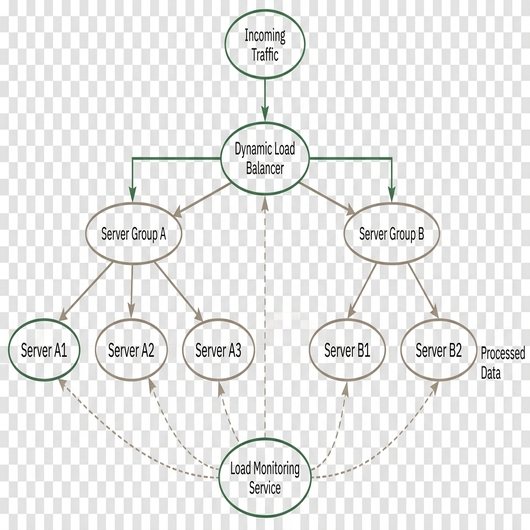
Where each method earns its keep
Static control suits small, predictable installations where the building load is steady and the charging duty is not time-critical. Think low-rotation workplace charging rather than a dispatch yard.
Dynamic control suits sites with variable building demand, mixed charging priorities, or vehicles arriving in uneven waves. It can lift charger output during off-peak facility hours and pull it back when the building load tightens. That is the practical advantage: it does not waste capacity simply because a conservative limit was written into the design months earlier.
- Static control: simpler design, fewer moving parts, lower flexibility.
- Dynamic control: more monitoring, more integration, better use of available capacity.
- Best fit for multi-bay hubs: dynamic control where charging demand and building demand both vary.
Key point: Static load balancing protects the site by capping demand. Dynamic load balancing protects the site while making better use of spare capacity as it appears.
Analyzing Peak Demand Patterns in Multi-Bay Sites
Charging demand has a timetable, but not a script
Commercial charging patterns look predictable until the vehicles arrive.
Fleet sites tend to show pressure around weekday dispatch windows, commonly 06:30-08:00 and 16:00-18:00. Morning demand comes from vehicles that were not fully charged overnight, last-minute substitutions, and drivers topping up before leaving. Late afternoon demand comes from returning vehicles, short-turnaround duties, and managers trying to prepare the next day’s schedule before the site closes.
The timetable helps. It does not give you concurrency.
Smart meter logs expose the overlap
Smart metering data is useful because it shows the shape of demand rather than a polite average. Concurrent charging sessions can vary from 2 to 9 vehicles within any 30-minute interval. That swing is exactly why fixed assumptions become fragile on larger hubs.
Community observation suggests that facility teams often underestimate the mid-day top-up. It is not always the longest charging event, but it can land during peak building activity. A service van returns early. A pool vehicle is needed again. A visitor charger is occupied longer than expected. None of these events looks dramatic on its own; together, they create the spike the breaker sees.
What to read before specifying controls
I would start with half-hourly import data, charger dwell patterns if chargers already exist, and operational schedules for the fleet or tenants. Do not just look for the highest import value. Look for the periods where building load and vehicle urgency coincide.
- Identify the normal building baseload outside charging activity.
- Mark the highest operational periods for the site, not just the electrical peaks.
- Overlay expected vehicle arrivals, departures, and dwell times.
- Check how often several chargers are likely to ramp together.
- Reserve capacity for safety systems, essential services, and future tenant changes.
Practical tip: Ask operations staff when vehicles are actually needed, not just when they are plugged in. Departure time is often the better design input.
The hard limit still matters
Dynamic load balancing optimizes available capacity; it does not create new supply capacity. If total baseline demand frequently exceeds the main fuse rating, physical DNO upgrades remain unavoidable. That limitation is specific and important: a clever controller can prevent overloading, but it cannot charge vehicles from capacity the site simply does not have.
This is where I draw a firm line in design reviews. If the building is already living too close to its electrical ceiling before EV charging is added, load management becomes a containment measure, not a growth strategy.
Cost Implications of Smart Load Balancing
CAPEX: control hardware versus supply reinforcement
Smart load balancing adds equipment. Current Transformers, smart meters, meter gateways, controllers, communications cabling, and commissioning time all sit in the capital cost column.
That cost should be compared against the alternative, not against doing nothing. A DNO upgrade can involve new service capacity, civil works, switchgear changes, shutdown planning, and programme risk. Even when reinforcement is eventually needed, dynamic control can allow a phased rollout instead of forcing the entire electrical upgrade before the first charger is useful.
CT clamp and controller hardware at the incoming supply can add in the ballpark of 4-7 days to the commissioning schedule. That is a real programme item, particularly on live commercial sites. But it is also a manageable item if it is built into the design rather than discovered after the chargers are mounted.
OPEX: demand charges and import discipline
The operational case is often stronger than the capital case. Smart control can help avoid demand excursions that push the site above its contracted import position. Maximum import capacity penalties can be triggered when demand sits above the contracted import capacity for more than 3 consecutive half-hour periods.
That matters because EV charging peaks are not always long, but they can be repeated. A busy return window can roll through several half-hour settlement periods if the hub is left unmanaged.
Dynamic control also supports better tariff behaviour. If a site has predictable off-peak windows, the system can use those periods more aggressively. If the building is under pressure, the chargers back off before the electrical account starts telling the story in penalty charges.
ROI for landlords and facility managers
For commercial landlords, the value sits in scalability. A controlled charging network can serve multiple tenants without giving the first tenant an uncontrolled claim on the building’s import capacity. For facility managers, the value is operational continuity. Charging should not compete blindly with the building it serves.
The better financial question is not, “How much does load balancing cost?” It is, “How much future capacity do we preserve by controlling demand from day one?” That is a sharper question, and it usually leads to a better specification.
- Use smart controls where charger numbers may grow.
- Reserve physical capacity for essential building loads before allocating EV demand.
- Model MIC exposure during dispatch and return windows, not only overnight charging.
- Include commissioning time for metering and controller validation in the project programme.
Implementing Dynamic Load Control Infrastructure
Put the measurement point where it belongs
The technical heart of dynamic load control is accurate measurement at the main incoming supply. CTs should be installed where they can read the total site import that the controller must protect. If the measurement point is wrong, the control decision is wrong.
During practice, I have seen an initial plan to locate CTs on individual distribution boards abandoned after voltage drop calculations showed unreliable readings beyond 25 m cable runs. The installation moved to the main incomer instead. That was the right call. A multi-bay hub needs a site-level view, not a partial view from a convenient board.
Readings can become unstable when CTs share trunking with variable-speed drives. Keep measurement wiring disciplined, route it sensibly, and test the signal under real site load, not just during a quiet commissioning slot.
Use OCPP as the control language
Open Charge Point Protocol gives the central system a standard way to speak to charging pedestals. In a dynamic arrangement, the meter gateway reports the site position, the management system calculates the safe allocation, and the chargers receive updated limits.
OCPP 1.6 JSON messages can be exchanged between the meter gateway and central system at intervals on the order of 1 second. The faster control loop helps when building loads move sharply, although the design still needs sensible ramp limits and fallback behaviour if communications are lost.
Do not treat OCPP as a magic compliance layer. It is a communication method. The electrical design still has to be correct, the protective devices still have to coordinate, and the installation still has to be tested properly.
Compliance points that should not be left late
UK installations need to align with recognised EV charging guidance and the applicable electrical installation requirements. The IET Code of Practice for EV Charging Equipment Installation, 3rd Edition, section 9.4 requires RCD protection on all final circuits supplying EVSE. That requirement should be designed into the distribution arrangement, not patched in after a failed inspection.

Smart charging functions also sit within a wider regulatory setting. For charge point behaviour and smart functionality, the government guidance on the Electric Vehicles (Smart Charge Points) Regulations is the right official reference point.
Performance can vary with a single-phase versus three-phase charger mix on the same feeder. Balance the phases deliberately, confirm neutral loading, and check that the controller understands the real charger configuration rather than a simplified version of it.
A practical deployment sequence
- Confirm the main incoming supply rating, protection arrangement, and contracted import capacity.
- Review half-hourly import data and operational charging windows before selecting charger quantities.
- Install CTs at the main incomer with suitable segregation from electrically noisy circuits.
- Commission the meter gateway and verify readings against the site meter under changing load.
- Configure OCPP communication between chargers, the management platform, and the meter gateway.
- Set site import limits, charger priorities, fallback limits, and alarm thresholds.
- Test the hub with multiple vehicles connected and the building operating under representative load.
Warning: Never leave the fallback charging limit undefined. If the controller loses metering data or communications, the chargers must drop to a safe pre-set output rather than continue at the last known allocation.
My recommendation is straightforward: for any commercial hub with several bays, variable building demand, or planned expansion, specify dynamic load balancing at the main incomer from the start and make it part of the electrical design package, not a software option added after commissioning.