Workplace EV charging is no longer a staff perk that facilities teams can leave for later. For many commercial premises, it has become part of the electrical brief: parking layout, load profile, billing, user control, and grant compliance all need to line up before the first charger is ordered.
This guide sets out the practical route through OLEV workplace charging grant requirements, EST-approved hardware, and the installation checks that usually decide whether a project runs cleanly or stalls at application stage.
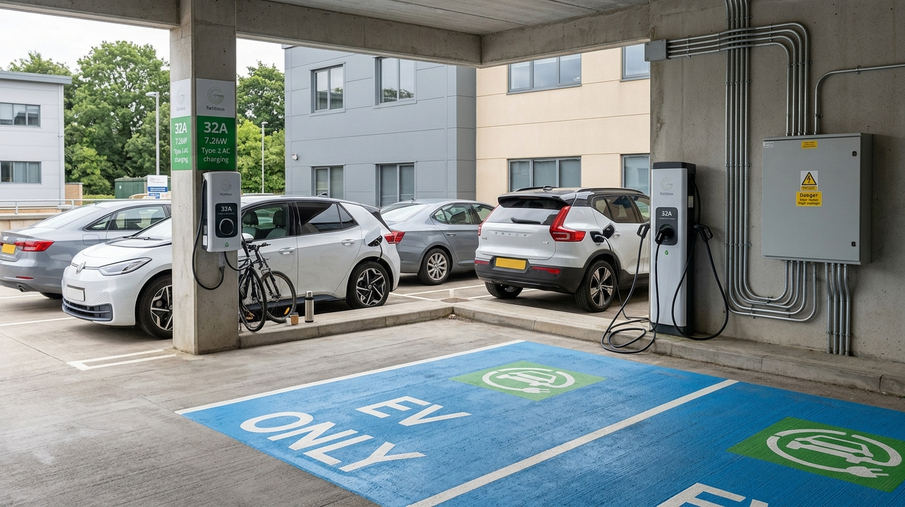
The Shift to Workplace EV Infrastructure
Why demand is moving into the working day
Commercial sites tend to see their charging pressure early. Reported peak workplace charging sessions commonly fall in the ballpark of the 07:30 to 09:15 weekday arrival window, which is exactly when staff arrive, fleet vehicles return from overnight use, and building electrical loads begin to rise.
That timing matters. A charger that looks modest on a drawing can become a problem when several sockets start together at the beginning of the day. The practical question is not just “how many chargers can fit in the car park?” It is “what happens when the building, the vehicles, and the occupants all ask for power at once?”
Supporting full EVs and plug-in hybrids
A well-planned workplace installation should serve both full battery electric vehicles and plug-in hybrids. In practice, this means avoiding over-specialised decisions too early. Staff cars, visitor vehicles, light commercial vans, and pool cars may all use the same parking area, but they rarely share the same dwell time or charging need.
Recent infrastructure upgrades typically added hovering around 4-8 sockets per location. That range is a useful planning reference because it reflects a staged approach rather than a one-socket trial that soon becomes too limited.
Future-proofing the commercial property
Future-proofing does not mean fitting the largest possible system on day one. It means preparing containment routes, distribution capacity, data connectivity, and parking allocation so the next phase is not treated as a new project from scratch.
Key Takeaway: Workplace charging should be designed around arrival patterns and electrical capacity, not just the number of marked bays available today.
Demystifying OLEV and EST Certifications
What the OLEV workplace grant is designed to support
The Workplace Charging Scheme is intended to help eligible organisations install charging sockets at commercial premises. Many teams still refer to it as OLEV funding, although official naming and departmental language have changed over time. The working principle remains simple: the grant supports compliant workplace charging when the applicant, site, equipment, and installer meet the scheme conditions.
The safest starting point is the official Workplace Charging Scheme guidance. It should be checked before procurement, not after a preferred charger has already been selected.

The role of EST-approved hardware
The Energy Saving Trust plays a gatekeeping role in the approval of eligible hardware. Current EST review timelines can run within a 4-6 week window after hardware submission, so a charger that is “under review” should not be treated as grant-ready on a live project programme.
Approved units must carry the current OLEV-compliant label issued after March 2021. This is one of those small details that can be missed during procurement when a model name looks familiar but the exact version, firmware route, or approval status has changed.
Why certified bodies matter for compliance
Using approved hardware and a competent installer is not box-ticking. It ties the installation back to grant evidence, electrical safety, socket operation, and the records needed when the application is submitted.
Community observation suggests that most avoidable delays occur before the application form is touched: the wrong hardware variant, unclear parking status, or no evidence of user control. The grant process is much easier when those points are settled at specification stage.
Pro Tip: Ask for the exact charger approval status, not just the brand name. Grant eligibility follows the approved unit, not the sales brochure.
Eligibility Criteria and Funding Limitations
Socket caps per commercial entity
Funding covers a maximum of 10 sockets per single commercial entity address. That cap should shape the first design conversation because it affects phasing, budget, and how the site separates staff charging from fleet charging.
A common mistake is to count charging units instead of sockets. For grant planning, the socket count is the figure that needs attention. A dual-socket unit can change the funding calculation even if it occupies one mounting position.
Dedicated off-street parking requirements
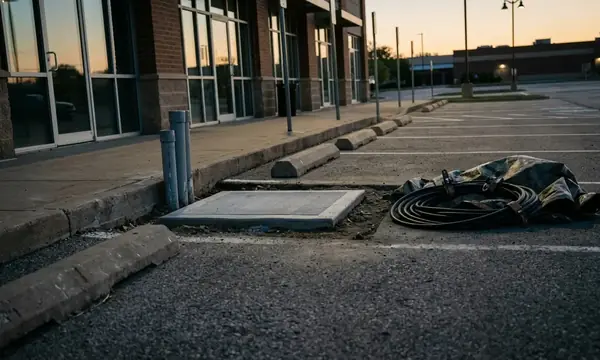
The parking area must be dedicated off-street parking, and the stated requirement is that it must be at least 20 metres from any public highway boundary. This needs to be verified on the site plan before electrical design advances too far.
Facilities teams should mark the proposed bays, cable routes, distribution board location, and highway boundary on the same drawing. When those items sit on separate sketches, small compliance problems tend to appear late.
Public access and fleet-only limitations
Public access voids eligibility even if sockets remain unused by external vehicles. That point is often misunderstood where a car park has mixed use, informal visitor access, or shared landlord control.
- Confirm who can physically enter the parking area during working hours.
- Confirm whether visitors, tenants, or members of the public can use the bays.
- Confirm whether the chargers will be reserved for employees, fleet vehicles, or authorised workplace users.
- Record the decision before the installer signs off the application evidence.
Warning: Do not assume an unused public-facing socket remains eligible. The access arrangement, not the usage history, is the compliance issue.
Essential Charger Features for Commercial Use
App-enabled authentication
Commercial chargers need controlled access. App-enabled authentication gives the site a practical way to separate authorised users from casual or unintended use, especially where staff parking and visitor parking sit close together.
The feature also helps with internal policy. A workplace may allow free charging for fleet vehicles, recover costs from staff, and restrict visitor access. Without authentication, those rules become notices on a wall rather than enforceable controls.
Monitoring for energy tracking and billing
A full monitoring system should log kWh per socket at intervals on the order of 15 minutes. That level of recording supports energy management, user reporting, and cost allocation without relying on rough assumptions from monthly electricity bills.
For facilities managers, the useful question is not whether the charger has a dashboard. The useful question is whether the data can answer site-level questions: which socket drew energy, when it drew it, and whether that draw coincided with known building peaks.
Load balancing across multiple sockets
Systems without load balancing fail during peak simultaneous charging. The risk is highest when several vehicles plug in during the same morning window and the building demand is already rising.
Load balancing units activate when total draw reaches a threshold trending toward 80% of the supply rating. That control protects the installation by reducing charger demand before the site reaches a more serious constraint.
- Use load balancing where several sockets share a constrained supply.
- Check whether balancing is local to the chargers or linked to whole-building demand.
- Confirm that the system records reductions in charge rate for later review.
- Avoid specifying chargers that cannot scale beyond the first small phase.
Variations occur based on regional grid capacity differences, so a design that works comfortably at one depot may need reinforcement or tighter controls at another.
The Installation and Application Process
Step-by-step route through the Workplace Charging Scheme
The application process works best when it is treated as an evidence trail. Each step should leave behind a drawing, calculation, product record, or site note that can be checked before submission.
- Confirm that the organisation and premises match the workplace scheme requirements.
- Identify the proposed charging bays and check the off-street parking condition.
- Select OLEV-compliant hardware with current approval status.
- Appoint an installer able to assess the electrical supply and provide scheme evidence.
- Complete the site survey and capacity assessment before finalising the number of sockets.
- Submit the application after installer sign-off and retain the supporting records.
Application processing after installer sign-off often takes 10-14 working days as a practical programme allowance. That period should be built into the project programme rather than treated as spare time between procurement and installation.
Site surveys and electrical capacity assessments
Initial site drawings are often prepared using existing electrical schematics before any physical inspection occurs. That is a sensible first step, provided nobody mistakes old drawings for site evidence.
The physical survey should verify board locations, spare ways, earthing arrangements, cable routes, parking bay positions, communications coverage, and likely installation disruption. Electrical capacity assessments require a minimum 48-hour monitoring period for a dependable site assessment, because a short snapshot will not show how the building behaves across ordinary use.
During practice, the most useful survey notes are the plain ones: where the cable can actually run, what needs landlord approval, what the distribution board can support, and where a charger would be vulnerable to impact damage.
Working with an independent EV charger installer
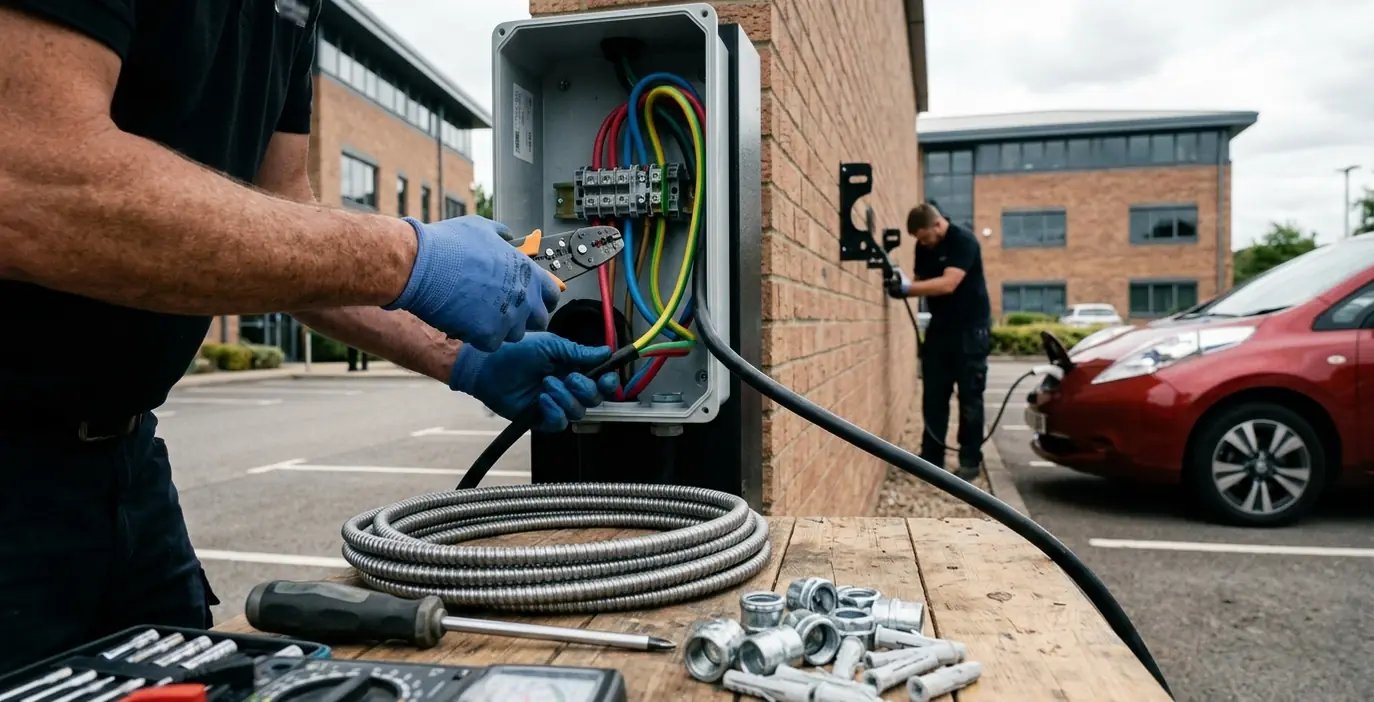
An independent EV charger installer such as SDM Electrical should bring the grant, electrical, and operational pieces together before the client commits to hardware. The installer’s role is not only to mount chargers. It is to test whether the proposed system is safe, eligible, maintainable, and suitable for the way the site will be used.
A first-principles approach is useful here. Start with the vehicles, the parking, the supply, and the user rules. Then select the charger. Reversing that order can leave the site with equipment that looks correct but does not satisfy the scheme or the building load profile.
The final specification should state the socket count, charger model, authentication method, monitoring arrangement, load balancing method, cable route, and grant evidence required. Grant outcomes still depend on the site’s parking layout and local network headroom, so the best projects leave no ambiguity in those two areas.
Key Takeaway: Treat the grant application and the electrical design as one process. If they are handled separately, the installer often has to repair decisions that should have been settled at the survey stage.