
The Impact of Lighting on Retail Energy Consumption
Why lighting deserves early attention
Retail lighting is rarely a small load. In many shops it runs for most of the trading day, then stays on for replenishment, cleaning, and security checks after the tills close.
Retail lighting systems often have daily runtimes in the ballpark of 12 to 14 hours. That single operating pattern explains why a modest wattage reduction at each fitting can matter more than a dramatic one-off saving elsewhere in the building. The load is repetitive, visible, and tied directly to the customer experience.
The awkward part is that retail teams cannot simply dim the store and call it efficient. Poor lighting changes how products read on the shelf. It can flatten textures, shift colours, create glare on packaging, and leave staff working in uneven light. A lighting upgrade has to reduce consumption while protecting the selling environment.
Where older systems lose money
Outdated fluorescent and halogen systems usually cost money in two ways: they draw more power than modern equivalents, and they create a maintenance rhythm that never quite stops. Fluorescent tube replacement cycles are often hovering around 18 to 24 months under continuous use, and that assumes access is straightforward.
In practice, the most overlooked cost is often disruption. A landlord may budget for lamps and labour, but not for the out-of-hours access, stock protection, temporary barriers, or repeated visits needed when fittings fail across different zones. Those details do not look dramatic on a spreadsheet, yet they shape the real operating cost.
Key Takeaway: Treat retail lighting as both an energy load and a trading condition. The best solution is not the lowest wattage fitting; it is the system that cuts waste without making the merchandise harder to assess.
Criteria for Evaluating Retail Lighting Solutions
Start with luminous efficacy
Luminous efficacy is the first baseline because it shows how much light a product produces for each watt consumed. Commercial LED fittings commonly sit around 100 to 130 lumens per watt, which gives facility managers a practical benchmark when comparing replacement options.
This figure should not be used in isolation. A high-efficacy fitting with poor beam control may waste light onto walls, ceilings, or display zones that do not need it. A slightly lower-rated fitting with the right optic can perform better in a narrow aisle or over a promotional table.
Check colour rendering before signing off
Colour Rendering Index matters in retail because customers judge products visually. CRI values above 80 are standard for accurate product colour rendering, and that threshold should be treated as a starting point for most retail environments.
For clothing, cosmetics, fresh produce, flooring, and homeware, colour errors are not minor technical issues. They become customer confidence issues. A coat that looks black under one fitting and blue at the doorway is a lighting problem the sales team will hear about.
Model lifespan, maintenance, and ROI together
Commercial landlords often compare fixtures by purchase price first. That is understandable, but it is too narrow. A proper assessment includes access requirements, replacement intervals, warranty coverage, controls compatibility, and the cost of keeping the trading floor safe while work is carried out.
- Luminous efficacy: Use lumens per watt to establish whether the fitting is in a sensible commercial LED range.
- Colour quality: Confirm CRI suitability for the product category rather than relying on a generic lighting schedule.
- Beam control: Match the optic to shelves, aisles, feature displays, or ambient zones.
- Maintenance access: Consider ceiling height, store opening hours, and whether equipment can reach the fittings safely.
- Controls readiness: Check whether the proposed fittings can work with dimming, sensors, or daylight harvesting if those are part of the plan.
Pro Tip: Ask suppliers for a sample fitting or a small trial area before committing to a full store rollout. Retail lighting is easier to judge under real merchandise, real ceiling heights, and real staff routines.
The Top 5 Energy-Efficient Lighting Solutions
1. High-CRI LED track lighting systems
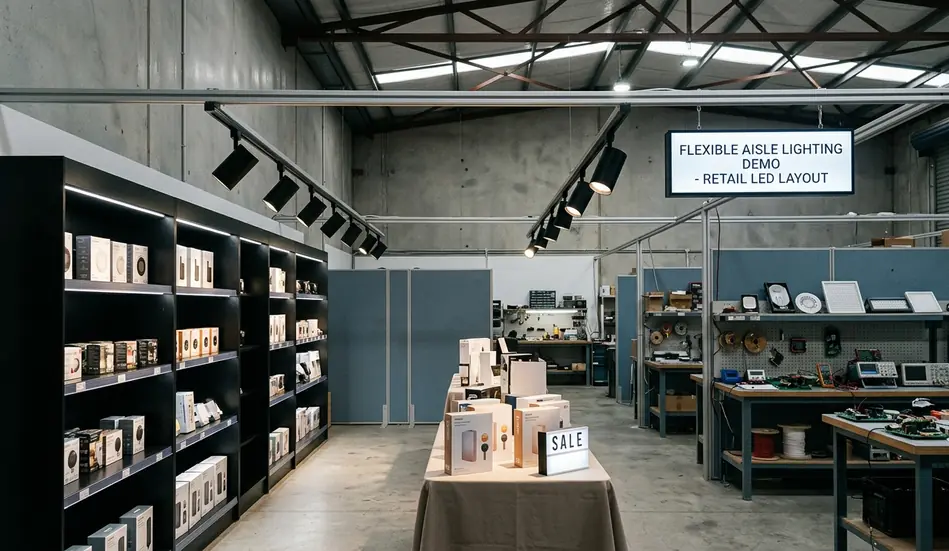
High-CRI LED track lighting is strongest where displays change often. It gives directional control, supports visual merchandising, and avoids the fixed feel of a uniform ceiling grid.
The main advantage is precision. Track heads can be aimed at feature tables, wall bays, seasonal displays, or premium ranges without lighting every square metre to the same intensity. For stores that refresh layouts frequently, this flexibility prevents the electrical system from dictating the merchandising plan.
It also suits phased upgrades. A retailer can start with the most visible sales zones, review glare and colour appearance, then extend the scheme once the team has seen how customers and staff respond.
2. Smart lighting controls and occupancy sensors
Controls are where many retail lighting schemes either become disciplined or become annoying. The design has to match foot traffic, store hours, and staff movement behind the scenes.
Occupancy sensors work well in stockrooms, staff areas, WCs, corridors, and secondary spaces where lights are often left running by habit. Sales floors need more care. Sudden switching can feel harsh, so dimming profiles should be set to protect the customer experience.
For larger sites, control zoning matters more than the brand of sensor. A front-of-house display area, fitting room corridor, back-of-house storage zone, and loading route do not behave the same way. They should not share the same control logic.
3. Retrofit LED troffers
Retrofit LED troffers are the practical choice for many stores with legacy fluorescent ceiling grids. They provide uniform ambient lighting and can reduce the maintenance burden linked to repeated tube replacement.
The best applications are straightforward retail areas where the ceiling grid is already doing useful work. Rather than redesigning the entire ceiling, the project replaces inefficient sources with LED panels or troffer units that fit the existing layout. That keeps disruption lower than a full architectural relight.
Glare still needs attention. A bright, flat panel can look efficient on paper but feel uncomfortable at the till point or over glossy packaging. Diffuser quality and ceiling position should be checked on site, not assumed from catalogue images.
4. Daylight harvesting systems
Daylight harvesting suits shops with usable glazing, rooflights, atria, or strong perimeter daylight. The system measures available natural light and adjusts the electric lighting output to maintain a steadier visual condition.
Daylight harvesting systems can be set to respond over short intervals during variable cloud cover. That response needs commissioning, because overly sensitive systems can create visible fluctuation that staff find distracting. The aim is not to chase every passing cloud; it is to avoid wasting electric light when daylight is already doing the work.
This approach is particularly useful near shopfronts, garden centre areas, glazed retail parks, and mixed-use commercial buildings where daylight changes by zone. It is less convincing in deep-plan units with little natural light reaching the sales floor.
5. High-bay LED fixtures
High-bay LED fixtures belong in retail spaces with volume: warehouse-style stores, trade counters, sports retail, furniture showrooms, and stock-heavy formats. In typical high-bay retail applications, they deliver output suitable for ceiling heights of 6 to 12 metres.
Performance varies with ceiling height above 4 metres. Beam angle, mounting position, and aisle layout should be checked before installation, especially where racking creates shadows. A fitting that works in an open showroom may be wrong for a narrow aisle with tall shelving.
Systems may underperform in high-humidity environments without proper sealing. That point matters for garden retail, chilled areas, and any space where condensation or moisture may shorten component life.
Warning: Do not select high-output LED fittings by wattage alone. Over-lighting a retail area can increase glare, waste energy, and make product presentation feel harsh rather than premium.
Scope, Limitations, and UK Compliance
CapEx and building constraints
Full smart lighting retrofits can carry high initial capital expenditure. That does not make them poor investments, but it does mean the business case must be built from the site condition rather than from a supplier brochure.
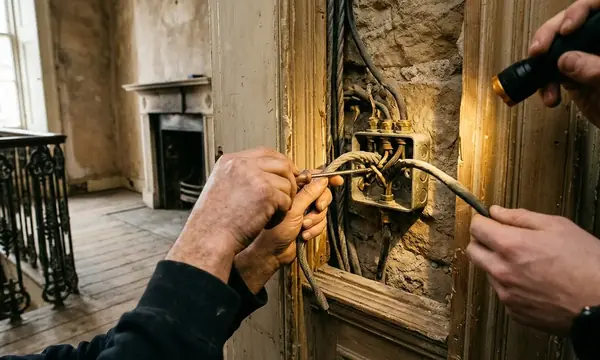
Older commercial buildings often impose the hardest limits. Retrofit projects in buildings constructed before 1990 can require additional conduit routing that adds on the order of 3 to 5 weeks. That programme risk should be discussed early with the landlord, tenant, electrical contractor, and any fire or security system stakeholders.
Older buildings with limited ceiling voids may require surface-mounted controls instead of recessed networked systems. This can affect appearance, cleaning access, and the route of containment. In heritage-sensitive or premium retail interiors, those details may decide whether a proposed control system is acceptable.
Compliance with UK non-domestic standards
UK non-domestic energy efficiency standards updated in 2022 mandate minimum efficacy thresholds for new installations. Facility managers should align lighting upgrades with Approved Document L of the UK Building Regulations when planning new work or significant replacement schemes.
The compliance route is not just a paperwork exercise. It affects fitting selection, controls strategy, commissioning records, and the evidence retained at handover. Shop layouts and landlord constraints can narrow the choice, so the design should be checked against the actual premises rather than a generic retail template.
Common mistakes to avoid
- Replacing lamps without checking whether existing drivers, diffusers, or controls are still appropriate.
- Installing sensors on the sales floor without testing customer-facing dimming behaviour.
- Using one colour temperature across every retail zone when the product categories need different treatment.
- Ignoring access equipment requirements for fittings above displays, escalators, or high racking.
- Failing to record commissioning settings, which makes later troubleshooting slower and less reliable.
Maximizing ROI on Lighting Upgrades
Run the audit before choosing the product
The first useful action is an energy audit, not a catalogue review. Initial energy audits typically review consumption data spanning the prior 12 to 24 months, which gives enough context to see trading cycles, seasonal changes, and abnormal usage patterns.
A good audit maps hours of use, fixture types, control arrangements, maintenance history, and the areas where staff regularly override the system. It should also capture complaints: glare at the counter, dim corners, poor colour over displays, or lights left on in back-of-house spaces. Those comments often point to the fastest operational wins.
- Collect energy consumption records for the previous 12 to 24 months.
- List existing fitting types, lamp types, control points, and maintenance issues.
- Identify trading-critical zones such as entrances, tills, fitting rooms, and feature displays.
- Check ceiling heights, access constraints, humidity exposure, and available ceiling voids.
- Compare replacement options using efficacy, CRI, warranty, control compatibility, and installation disruption.
- Trial the preferred solution in a representative area before committing to the full programme.
Calculate payback with maintenance in view
ROI calculations should include energy reduction and avoided maintenance. They should also incorporate fixture warranties extending 5 to 7 years, because warranty coverage changes the risk profile of the investment.
The strongest retail schemes usually combine several measures rather than relying on one product type. Track lighting may handle feature displays, troffers may solve ambient coverage, sensors may reduce waste in staff areas, and daylight harvesting may manage the shopfront. That mix is not fashionable; it is simply how retail buildings behave.
For facility managers, the sensible route is measured and staged. Audit first, trial second, install third, then verify that the lighting still supports the way the store trades. Energy-efficient lighting earns its place when lower consumption, easier maintenance, and better visual control all show up in the same project file.