The Hidden Risks of Office Renovations
Why electrical infrastructure gets pushed too late
In commercial renovations, the visible work usually wins attention first: partitions, finishes, glazing, furniture, reception areas. Electrical infrastructure sits behind ceiling tiles and risers, so it is often treated as a service to be adjusted once the layout is fixed. That order causes trouble.
The risk is not simply that a few sockets end up in the wrong place. The deeper issue is that the renovated office may ask an old installation to behave like a modern power platform. Legacy 1980s distribution boards rated on the order of 200A often lack spare ways for added circuits, and that becomes apparent only when the design team starts adding meeting room AV, desk power, access control, comms cabinets, and mechanical controls.
The cost of underestimating power
Overloaded circuits in high-density setups without prior load mapping are a familiar pattern on refurbishment sites. The floor plan looks efficient, then the electrical schedule reveals a concentration of small loads that are not small when they operate together.
The operational cost is usually disruption rather than a neat line item. Tenants lose access to zones. Ceiling works reopen. Distribution boards need revised labelling and sometimes replacement. A project that seemed close to completion has to step back into investigation, isolation, and rework.
Warning: Treating electrical design as a late-stage fit-out task can lock the project into expensive compromises before anyone has calculated the actual demand.
Modern layouts need different architecture
Legacy offices were often arranged around lower-density desk areas, fewer electronically controlled systems, and simpler plant interfaces. Modern offices behave differently. They concentrate people, screens, chargers, collaboration spaces, badge-controlled doors, wireless infrastructure, and building management devices into tighter zones.
That changes the architecture. The design needs distribution capacity, containment routes, isolation points, segregation for data and power, and resilience for rooms that cannot tolerate casual downtime. The best renovation plans recognise this before strip-out begins.
Assessing Existing Commercial Infrastructure
Start with measured load analysis
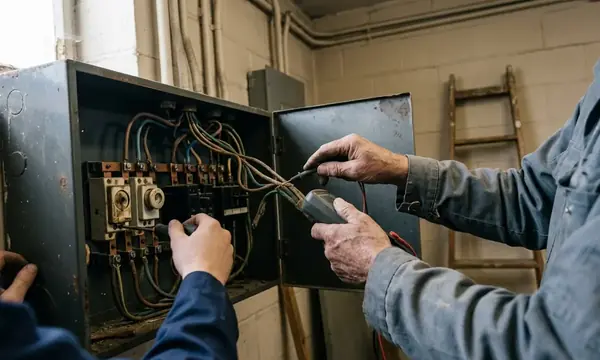
A proper assessment begins at the distribution boards, not at the new furniture plan. The team should identify existing circuits, board ratings, spare ways, protective devices, earthing arrangements, and the practical routes available for new containment.
Load analysis is normally completed across 3-5 business days. That window gives enough time to see routine operating patterns rather than relying on a single point-in-time reading. It also helps separate genuine spare capacity from capacity that only appears spare because part of the office is temporarily quiet.
- Record the current distribution board configuration and circuit schedules.
- Verify loads against actual use, not only against old drawings.
- Check protective devices, labelling, and isolation arrangements.
- Compare measured demand with the proposed renovated layout.
- Flag capacity restrictions before procurement or ceiling closure.
Visual inspections miss concealed problems
During practice, early reliance on visual inspections was abandoned after concealed junction boxes were found in three separate projects. The lesson was direct: if the installation history is incomplete, assume the ceiling void may contain decisions that never reached the drawing register.
This is not a criticism of every older installation. Many have been maintained carefully. The issue is that commercial premises often pass through several fit-out cycles, and each cycle can leave behind altered circuits, redundant containment, or undocumented connections.
How experienced engineers spot bottlenecks
In large-scale firm environments, capacity bottlenecks rarely announce themselves as one obvious defect. They show up as a pattern: crowded boards, limited riser access, long routes back to plant areas, unclear circuit identification, and equipment rooms fed as if they were ordinary office zones.
EICR intervals are commonly set at 5 years for commercial premises, but a renovation should not wait for the calendar if the work materially changes the installation. An EICR before renovation establishes the condition baseline. A follow-up after completion confirms that the new work and retained infrastructure sit together coherently.
Designing for Modern Power Demands
Map demand before fixing the layout
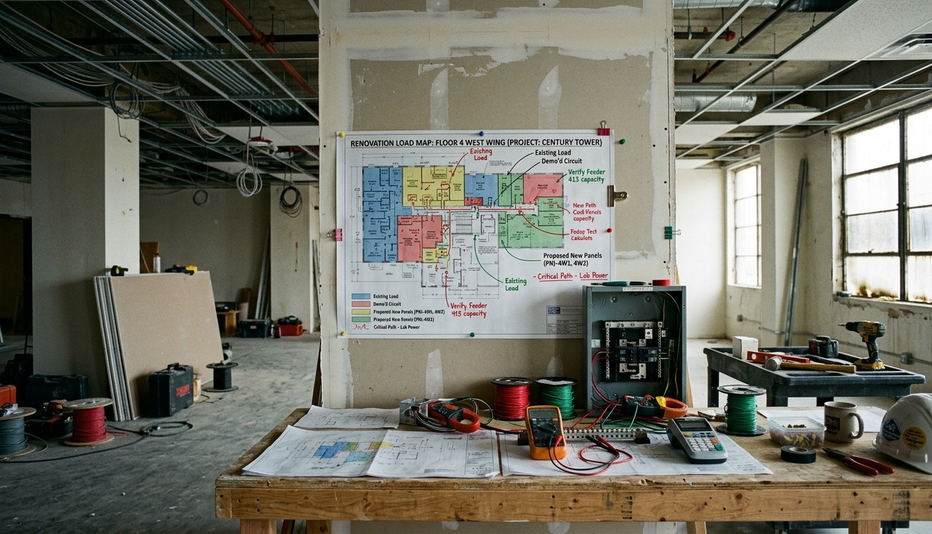
The design conclusion is simple: map the power demand first, then commit to the office layout. High-density workstation areas, collaboration rooms, print points, kitchenettes, access control equipment, and server spaces should all be scheduled before containment routes are frozen.
Server room circuits need particular care because they are not intermittent office loads. Circuits sized for 10-15 kW continuous draw require a different conversation about ventilation, resilience, isolation, and monitoring. The electrical design cannot be separated from the mechanical design in those rooms.
Integrate controls as real loads
Smart HVAC controls and automated lighting systems are sometimes discussed as efficiency measures only. On site, they are also wiring, containment, commissioning, and fault-finding responsibilities.
Lighting control modules need accessible positions. Sensors need sensible zones. HVAC interfaces need coordination with the building management system rather than last-minute local switching. When these systems are designed as part of the electrical package, the contractor can test them in sequence instead of chasing faults after handover.
Plan EV infrastructure even when chargers come later
Commercial parking areas are increasingly part of the infrastructure conversation. A renovation may not include immediate charger installation, but conduit pathways should still be planned if adjacent parking is likely to need EV charging.
Conduit runs for 7-10 EV chargers at 7 kW each affect routes, space, containment, and future isolation strategy. Installing sensible pathways during renovation is usually cleaner than cutting through finished areas later. The electrical load still needs confirmation against available supply; empty conduit does not create capacity.
Pro Tip: Keep future EV routes separate in the design notes from approved live circuits, so later works do not get mistaken for already validated capacity.
Navigating UK Electrical Compliance Standards
Apply BS 7671 to the new work and the interfaces
Commercial renovations must align with current wiring requirements, including BS 7671:2018+A2:2022 amendments for all new commercial circuits. The practical challenge is often at the boundary between new installation work and retained infrastructure.
Engineers should check how new circuits connect into existing boards, whether protective devices remain suitable, and whether the earthing and bonding arrangements still support the revised installation. Official guidance on UK electrical safety standards is a useful reference point, but the project still needs site-specific verification.
Use the EICR before and after renovation
The pre-renovation EICR identifies condition, defects, and constraints before design assumptions become expensive. The post-renovation EICR confirms that the completed installation has been inspected and tested in its final context.
Project experience suggests that the most useful reports are not the longest ones. They are the reports that clearly distinguish immediate safety issues, design constraints, and items suitable for planned improvement.
Contracting discipline matters
SDM Electrical approaches commercial electrical contracting through documented design review, staged inspection, test records, and controlled handover packs. That method is how strict regulatory adherence can be guaranteed for the contractor-controlled works. The practical qualifier is important: DNO capacity decisions and upstream network constraints sit outside the contractor’s direct control.
Good compliance work is not paperwork after the fact. It shapes the sequencing, procurement, isolation planning, and commissioning method from the start.
Scope and Limitations of Infrastructure Upgrades
Know where contractor responsibility ends
The contractor can assess, design, install, test, and document the internal electrical infrastructure. The Distribution Network Operator controls the incoming supply and the upstream network. Confusing those responsibilities leads to unrealistic programmes.
One catch matters more than many project teams expect: internal panel upgrades cannot proceed if the incoming supply remains capped below required capacity. A larger internal board does not solve a constrained main supply. It may only make the limitation look tidier.
DNO timing changes the renovation programme
Major supply upgrades can require in the ballpark of 4-6 months lead time before internal works start. Variations in DNO response times based on regional grid capacity can stretch the early planning stage, especially where the local network already carries heavy demand.
This is a seasonal and commercial planning issue as much as an engineering issue. If a landlord wants works completed between tenant occupation cycles, the DNO application cannot wait until the fit-out contractor is appointed. It belongs in the feasibility stage.
What to avoid
- Do not order new switchgear before confirming incoming supply constraints.
- Do not assume spare physical space in a riser means spare electrical capacity.
- Do not leave DNO applications until the internal design is already committed.
- Do not promise tenant load availability without a recorded capacity position.
Step-by-Step Project Execution
Phase the works around occupied areas
Execution works best when the electrical package is phased around tenant access, isolation windows, and ceiling closure dates. The contractor should agree which areas can be isolated, when noisy works are allowed, and how temporary supplies will be controlled.
- Confirm the existing condition through survey, load analysis, and EICR findings.
- Freeze the electrical design against the approved layout and known capacity.
- Coordinate containment routes with mechanical, fire, data, and ceiling trades.
- Complete first-fix works before finishes restrict access.
- Install accessories, controls, and final connections during second-fix.
- Commission, load test, label, and hand over the completed installation records.
Coordinate first-fix and second-fix properly
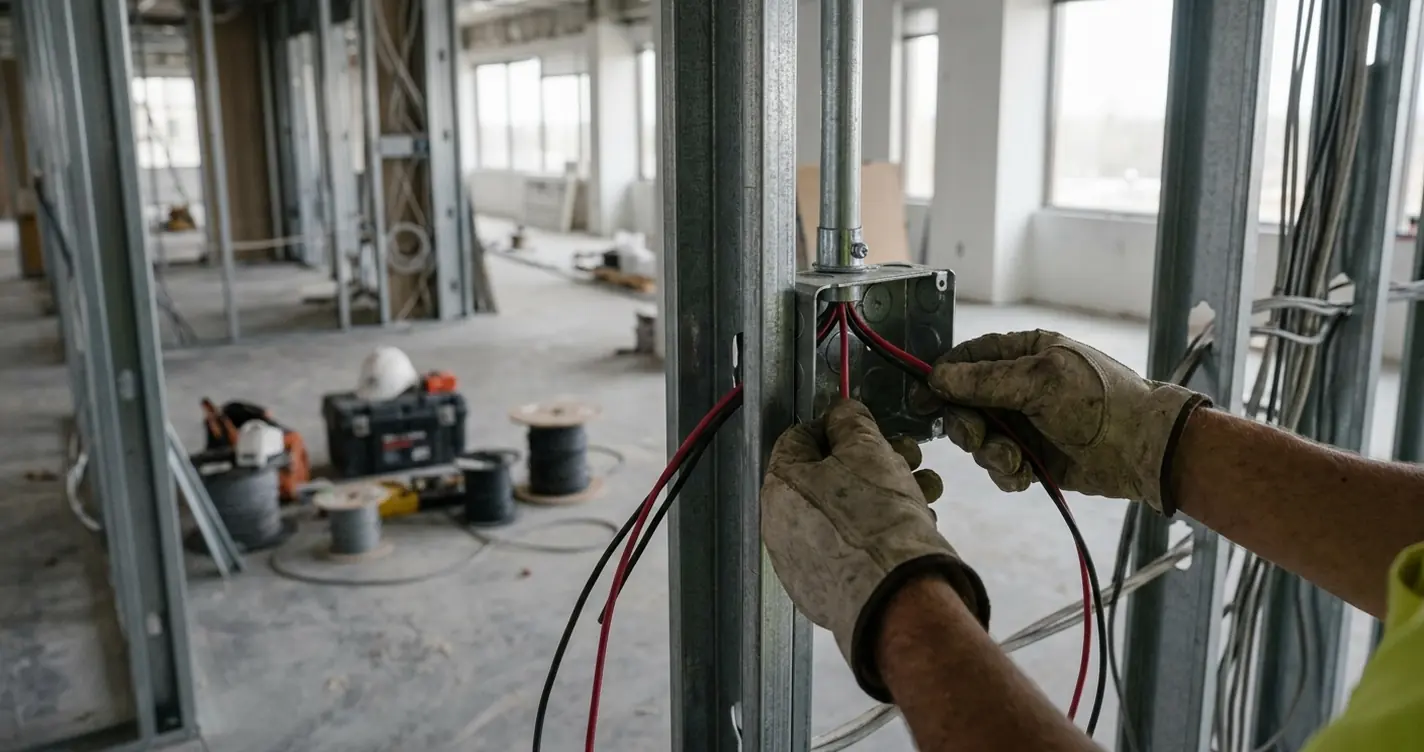
First-fix is commonly completed 2-3 weeks ahead of second-fix to align with other trades. That gap is useful. It allows containment, cable routes, back boxes, and board works to be inspected before ceilings and finishes limit access.
Second-fix then becomes controlled completion rather than excavation. Accessories, luminaires, controls, distribution labelling, and final terminations can proceed with fewer clashes if the first-fix record is accurate.
Commissioning and handover
Final commissioning should include inspection, testing, load checks, circuit schedules, distribution board labelling, certificates, and operating information for the facilities team. Handover documents need to be usable, not merely archived.
A facilities manager should be able to identify what changed, which circuits serve critical areas, where isolation points sit, and what future capacity assumptions remain. That is the difference between a renovation that looks complete and an infrastructure upgrade that can be maintained safely.
Key Takeaway: Commercial electrical renovation succeeds when capacity, compliance, DNO constraints, and phasing are treated as core design inputs from the first survey.