
Facility managers across Central Scotland face a hard ceiling the moment new EV charging systems or electrified plant push simultaneous demand past the figure printed on the DNO connection agreement. That figure is the Maximum Import Capacity. Crossing it turns an internal electrical job into a commercial grid connection project.
Table of Contents
- Defining the Commercial Grid Connection
- Assessing Central Scotland's Infrastructure Conditions
- Analyzing Your Site's True Capacity Deficit
- The DNO Application and Design Phase
- Navigating Connection Offers and Queues
- Project Execution and Final Energization
- The Reality of Network Physics
Defining the Commercial Grid Connection
A commercial grid connection project is the physical and legal process of increasing a site's Maximum Import Capacity by integrating new infrastructure with the local Distribution Network Operator's existing network. MIC is stated in kVA on the connection agreement and forms the hard contractual ceiling for import.
Standard internal modifications stop at the customer switchboard. Grid connection upgrades do not. They reach into external network physics and require regulatory approvals before a single trench is cut. External works commonly need a new boundary joint or an intake cubicle rated for the uplifted capacity.
Three parties sit at the centre of every project:
- the Distribution Network Operator, which owns and operates the public network
- the Independent Connection Provider, which can deliver contestable on-site works
- the facility's existing electrical infrastructure, which must accept the new intake without cascading faults
Classify the job only after comparing proposed simultaneous load against the MIC on the current agreement. Any uplift that crosses that line is a grid connection project, full stop.
Assessing Central Scotland's Infrastructure Conditions
SP Energy Networks operates the distribution network across Central and Southern Scotland. Capacity checks begin at the primary substation serving the site postcode.
Primary substations across the central belt have absorbed successive commercial EV depot and electrified-heating loads over recent planning cycles. Firm headroom that looked comfortable in earlier assessments is often already allocated to earlier applicants. When that happens, the review shifts: does the location sit inside an Active Network Management area?
ANM schemes change the commercial risk profile. Rather than funding massive physical reinforcement, the DNO may issue curtailment instructions within minutes when local thermal or reverse-power limits are approached. A site can hold a higher MIC on paper and still lose usable power during peak grid stress.
ANM Site Check
Confirm ANM status for the serving primary before locking capital budgets. Curtailment exposure belongs in the business case, not as a surprise after energization.
Regional projects that ignore these constraints waste months chasing offers that later arrive with heavy reinforcement costs or interactive-queue flags.
Analyzing Your Site's True Capacity Deficit
Nameplate summation looks rigorous and fails in practice. Audit teams that total every planned EV charger and HVAC unit at full rating produce an inflated deficit and oversize the application. The workable baseline comes from half-hourly settlement data pulled for a continuous 12-month window using the most recent available data.
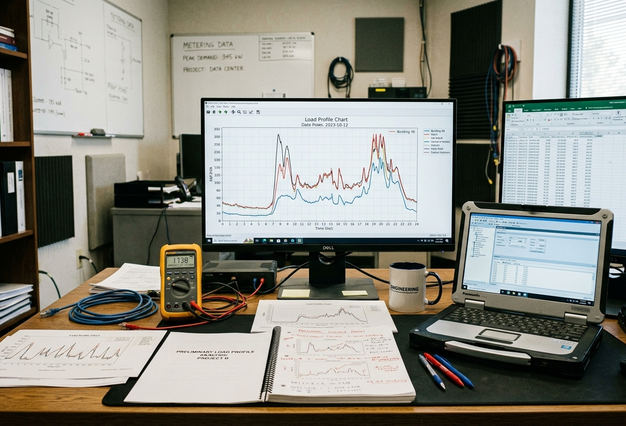
Plot that year of import against the existing MIC. The gap between observed peaks and the contractual ceiling is the true starting point. Projected future demand then sits on top of that baseline, not on a stack of simultaneous nameplate figures.
Diversity factors matter, and they are site-specific. Diversity for mixed EV and HVAC additions is derived from expected coincidence on that specific site rather than a single blanket multiplier. Diversity assumptions that hold for a multi-tenant office park fail on a single-occupier logistics depot where EV chargers and cold stores peak together.
Pre-Application Capacity Audit Checklist
- Export 12 months of half-hourly import data from the settlement meter
- Confirm current MIC from the existing DNO connection agreement
- List all planned new loads with individual kW ratings and expected operating schedules
- Apply site-specific coincidence rather than a generic diversity factor
- Calculate the deficit between current MIC and realistic simultaneous future demand
- Flag whether the serving primary sits in an ANM zone
The DNO Application and Design Phase
Freeze the load schedule and single-line diagram first. Assemble the application package only after those documents stop moving, then check every item against the DNO minimum-information list so the formal design clock does not reset on a missing drawing.
Routine commercial applications typically cover upgrades up to roughly 1 MVA on the standard design track. Sites needing high-voltage connections or multi-megawatt industrial supplies enter extended feasibility studies under separate timelines and different regulatory frameworks governing electricity network access. This guide tracks the standard commercial path; bulk HV work follows its own sequence.
Design responses for complete LV/HV upgrade applications commonly return within 8 to 16 weeks when the submission is clean.
Contestable and Non-Contestable Scope
Contestable works cover on-site cabling and customer-side substation build. An ICP can price and deliver that package. Non-contestable items stay with the DNO: live joints onto DNO assets, certain protection settings, and final network integration steps. Split the programme early so procurement and programme risk sit with the right party.
Submission Freeze Point
Submit only when the load schedule is locked. Mid-design revisions restart the information check and push the offer date out.
Navigating Connection Offers and Queues
Open the offer on the reinforcement cost line and any interactive-queue flag. Accepting a connection offer without isolating the reinforcement cost line can lock the project into unaffordable upstream works. Finance must confirm capital exposure before anyone signs.
Interactive queue status means another applicant sharing the same constrained substation can reduce remaining capacity if they accept first. Central Scotland has seen this pattern intensify wherever commercial EV fleets and heat electrification cluster on the same primary.
Connection offers carry a fixed acceptance window, commonly 45 to 90 days from the issue date. Missing the acceptance deadline voids the offer and returns the project to the rear of the regional queue. Legal review of special conditions belongs inside that window, not after it.
Offer Clock Risk
Diary the acceptance deadline the day the offer lands. Queue position is perishable.
Project Execution and Final Energization
Lock execution order at a joint kick-off between the facility manager, the ICP, and the DNO. Trenching and switchgear delivery must avoid the facility's peak trading hours. The ICP runs the contestable programme while the DNO books the final non-contestable joint.
New intake switchgear and any on-site package substation are positioned and tested before the DNO attends for the final connection joint. Witness testing and compliance certification sit in the days immediately before energization. Cut-over outages are typically booked in 4- to 8-hour blocks outside core operating periods.
Coordination fails when the facility treats energization as a pure contractor milestone. Ongoing commercial operations need a named internal owner who can halt non-essential load during the cut-over window and confirm restoration sequences with the ICP.
The Reality of Network Physics
A grid connection is a physical integration into a massive, synchronized machine. Final sign-off treats the new MIC as a physical commitment to that system, not a paper entitlement. The load profile submitted at application stays as the reference against which post-energization behaviour is judged. Inaccurate profiling later surfaces as unexpected demand charges or ANM curtailment once the upgraded capacity is live.
The entire Great Britain transmission system holds frequency at a nominal 50 Hz through continuous second-by-second balancing across thousands of miles of interconnected infrastructure.