Why Central Scotland’s Business Parks Face Grid Constraints
Historically, grid capacity in Central Scotland was allocated to large, single-site industrial users. Today, a business park can sit close to a major industrial corridor and still receive an expensive electricity connection offer. The relevant constraint is often the nearest primary substation or 11 kV feeder.
Much of the Forth-side 33 kV network was built around concentrated petrochemical and steel demand at a small number of sites. Network planners retained radial 33 kV routes after those loads changed; rebuilding them as a meshed network would have required prolonged, seasonal outages along the corridor. Today, logistics sheds, data halls and depot chargers draw power across many more connections, often from the same 11 kV boards.
Constraint notices accumulated on commercial-park feeders as local primaries approached continuous rating through the working day. Connection offers increasingly included 11 kV circuit extensions. For a facility manager, that could put a substantial network charge into a project whose own electrical installation was otherwise straightforward. The location of the constrained primary shaped the quote as much as the applicant’s requested load.
The six reinforcement schemes address different parts of that problem. Their sequence follows stalled connection queues and the constraints on each corridor, rather than a single region-wide increase in capacity.
What Each of the Six Reinforcement Schemes Changes
Delivery is staggered across the 2023–2028 price-control period. That distinction matters when assessing a connection offer: a scheme planned for a corridor does not release capacity at every downstream board on the same day. The SP Energy Networks distribution infrastructure pages provide a starting point for identifying the relevant network before asking the Distribution Network Operator (DNO) about a specific site.
Grangemouth: Transformer Capacity for Industrial Loads
Grangemouth’s work centres on replacing aging primary transformers in the 12/24 MVA class. Heavy plant needs a firm supply, while neighbouring commercial connections add demand to the same part of the network. Transformer condition and fault-level constraints coincide on these boards, so a replacement must be assessed for both usable capacity and the equipment’s ability to withstand faults.
A nearby business should still identify its actual point of connection. A transformer upgrade at the primary cannot, by itself, clear a constraint on a separate downstream circuit.
Falkirk: Closing the Distribution Ring
Falkirk’s reinforcements add high-voltage cable routes around expanding retail and business parks. Closing the distribution ring gives the DNO more options to maintain supply while sections are taken out of service. Transformer and cable outages are booked in 8- to 14-day blocks on a shared schedule, so tenants planning switchovers should distinguish the network construction window from their own planned shutdown.
Stirling: Headroom for Solar PV and Batteries
The Stirling expansions focus on reverse-power flow and voltage headroom. Rooftop solar PV and on-site batteries can push electricity back through equipment originally operated mainly for import. More headroom reduces the risk of nuisance trips when commercial systems export. A landlord considering chargers alongside PV should ask about import and export capacity separately; one approval does not establish the other.
Glasgow Fringe and Two Secondary Boards
On the Glasgow fringe, substation modernisation is intended to make firm connections available in place of active network management (ANM) arrangements that restrict load when the network is busy. The remaining two schemes address unnamed secondary-substation boards where voltage sags during the 17:00–19:30 winter peak. These are local interventions, so their benefit depends on which board actually serves the proposed development.
Where Released Capacity Helps a Facility Upgrade
Firm primary capacity can change the economics of rapid fleet charging. With demand hovering around 150 kW per bay, simultaneous charging soon becomes a board-level demand. An operator comparing an ANM connection with a firm one should test each offer against the fleet’s dispatch schedule: a charger that must reduce power during a busy charging window may leave vehicles short of the energy needed for their next run.
Timing matters as much as charger specification. A facility team can lodge an upgrade request on the order of 9 to 15 months ahead of a published reinforcement energisation date, then ask the DNO to price the connection against the capacity expected to be available. The written offer must identify any residual works and charges. Filing early alone does not remove a first-comer contribution if the site needs a separate network extension.
The metering point is the budget boundary. The regional schemes release DNO-side capacity; a privately owned 11 kV/400 V transformer, LV switchgear and on-site cables remain the occupier’s responsibility. Check their ratings, condition and protection arrangements before assigning a saving from primary reinforcement to the project budget.
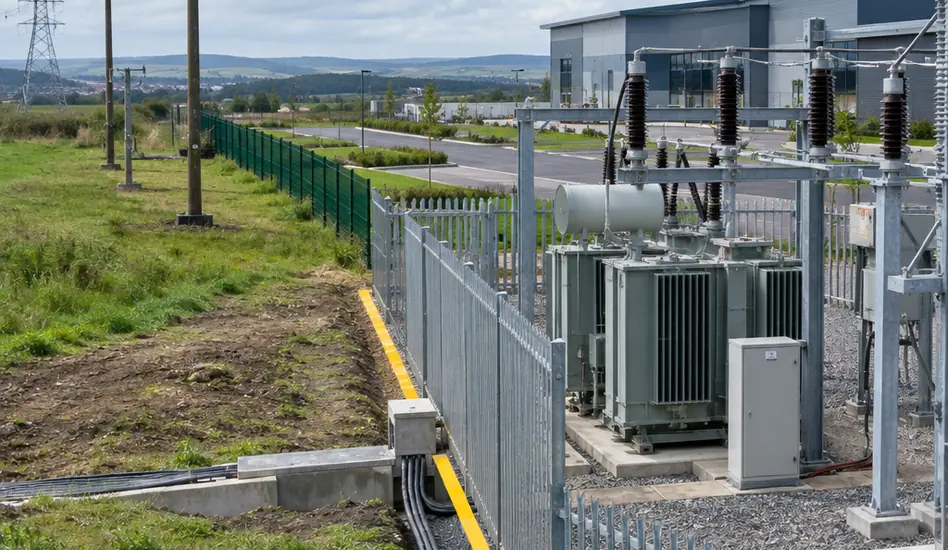
For commercial infrastructure programmes, that split gives the project team two workstreams: obtain a connection offer tied to the relevant scheme, and design the site installation for its proposed maximum demand. The two programmes can run together, but energisation depends on both being ready.
A Stirling Landlord’s Ten-Bay Charging Programme
Consider a landlord preparing a ten-bay hub in a Stirling business park. The design brief allows every bay to deliver a concurrent 150 kW session, making charger demand 1.5 MW before the existing premises load is added. The consultant schedules the project against the local reinforcement date rather than the car-park construction finish, because completed bays cannot be energised without available network headroom.
From Demand Profile to Energisation
- Establish the baseline. Request the site’s maximum-demand profile and confirm its agreed import capacity. Record the highest coincident premises demand, then compare the spare capacity with the proposed 1.5 MW charging load. Give the DNO the resulting shortfall and the assumption that all ten chargers may operate together. This avoids basing the application on a charger nameplate total without the existing building load.
- Match the shortfall to the network programme. Cross-reference the serving board and required import capacity with the DNO’s published Stirling reinforcement schedule. Submit the connection request ahead of the planned energisation and ask for an offer that identifies whether the application would otherwise fund an upgrade as first comer. Check the offer’s connection point, capacity date and any residual charges before committing to the charger order.
- Build the site while the board remains constrained. Programme the civils, ducts and charger bodies into a 6- to 10-week installation window. In parallel, complete the private-transformer, switchgear and cable design and carry out compliance & testing on the finished installation. Keep the chargers isolated from the new load until the DNO confirms the primary work is complete and authorises energisation. The landlord can then commission the ten bays against the agreed import limit and hand over a charging hub that matches the connection offer.