
An Electrical Installation Condition Report records the condition of a commercial installation at the time of inspection. When the result is Unsatisfactory, the report also creates a visible trail of unresolved hazards. Facility teams need to control that trail from the first make-safe action through to the final completion certificate.
The practical test is simple: can the duty holder match every C1, C2 and FI observation to an action, an accountable person and suitable close-out evidence?
How the EICR Turned Observations Into Actions
Before 2012, many commercial records contained a Periodic Inspection Report, usually referred to as a PIR. Its numbered observation codes ranked issues from 1 to 4. The format recorded concerns, but the connection between individual observations and the overall status of the installation was less direct.
That changed on 1 January 2012. The model forms introduced by BS 7671:2008 Amendment 1 replaced the PIR with the Electrical Installation Condition Report. The new form used C1, C2, C3 and FI codes and linked them to a single Satisfactory or Unsatisfactory result.
The Codes That Control the Result
- C1: Danger is present and immediate action is required.
- C2: The condition is potentially dangerous and requires urgent remedial work.
- C3: Improvement is recommended, while the installation may still receive a Satisfactory result.
- FI: Further investigation is required because an essential inspection or test remains incomplete.
Any C1, C2 or FI observation forces an Unsatisfactory assessment. That design matters. The model-forms group preparing Amendment 1 mapped each observation to a lettered code that feeds the overall result, making rectification part of the reporting process rather than a detached recommendation.
The form also changed how compliance & testing was discussed with insurers, landlords and operational managers. A fault could no longer sit quietly as a ranked comment in the back of a report. The front-page result showed whether unresolved observations affected continued confidence in the installation.
C3 Stays Distinct
A report can remain Satisfactory with C3 observations. Facility teams should track those recommendations, especially where future commercial infrastructure work is planned, but C3 does not carry the same effect as C1, C2 or FI.
Why an Unsatisfactory EICR Cannot Sit in the Compliance Folder
A recurring operational problem begins on the day the report arrives. The facility manager scans the EICR, uploads it to the compliance folder and closes the inspection task. The observation pages remain unread until a tenant raises a query or an insurance renewal brings the report back into view.
At that point, the document has done more than record an inspection. It has preserved written notice that the installation contained known danger, potential danger or an unresolved condition requiring investigation.
Possession Creates an Evidence Trail
An Unsatisfactory EICR stays on file in that state until each C1, C2 and FI observation has matching close-out evidence. If an electrical incident occurs while those items remain open, the report can demonstrate that the duty holder knew about the hazard before the event.
This is particularly serious for a commercial landlord. A dated inspection, a coded observation and no corresponding repair record create a clear sequence for an investigator to follow. An internal note saying that work was intended offers little value when there is no approved order, contractor attendance record or electrical certificate.
The report should therefore enter a live defect process on receipt. Someone must review the result, identify affected circuits or areas, confirm any temporary controls and assign each observation to a repair or investigation route. Filing remains necessary, but it comes after triage rather than replacing it.
The Same-Day Control Check
- Confirm whether the overall result is Satisfactory or Unsatisfactory.
- Read every C1, C2 and FI entry, including the stated location and observation number.
- Verify that each C1 circuit has been isolated or otherwise made safe.
- Record who owns the next action for every C2 and FI item.
- Keep the report open in the facility defect register until suitable certification closes the coded observations.
Known Hazard Record
Leaving an Unsatisfactory report untouched can increase legal exposure because the duty holder possesses a document that identifies the unresolved electrical risk in plain terms.
Sorting C1, C2 and FI Work by Actual Risk
The three codes that produce an Unsatisfactory result require different responses. Treating them as one repair list can obscure a present danger or leave an unknown condition energised for too long.
C1 Requires Immediate Control
A C1 records danger present. The inspecting engineer decides the immediate action on site and must isolate the affected circuit or otherwise make it safe before leaving. The facility team should obtain a clear record of that action, including the relevant observation number and the equipment or circuit affected.
Operational pressure cannot override this step. If isolation interrupts a tenant area or a commercial process, the outage becomes an active facility incident to manage. Re-energisation should follow appropriate remedial work and verification rather than an informal request to restore service.
C2 Needs an Urgent Repair Window
A C2 item is potentially dangerous. It may remain energised only where the immediate circumstances and any temporary measures allow the risk to be controlled while remedial work is arranged.
For practical scheduling, the supplied methodology places C2 repairs into a 10-to-28-calendar-day window rather than automatically waiting for the next major shutdown. That window supports procurement and access planning, but it does not reduce the significance of the code. A competent person still needs to review the individual observation and decide whether a shorter response is required.
FI Is an Unresolved Technical Question
FI often receives less attention because it does not describe a confirmed defect. In practice, the missing information may conceal a serious infrastructure issue.
The code applies when a mandatory inspection or test could not be completed. Examples include a live essential circuit that could not be isolated during trading hours or main bonding hidden beneath a sealed raised floor. Until the test or inspection is completed, the severity remains unknown.
That uncertainty calls for a defined diagnostic plan: secure an isolation window, obtain access to the concealed area, complete the missed test and record the result. If the investigation identifies a defect, the resulting work then follows the appropriate repair and certification route.
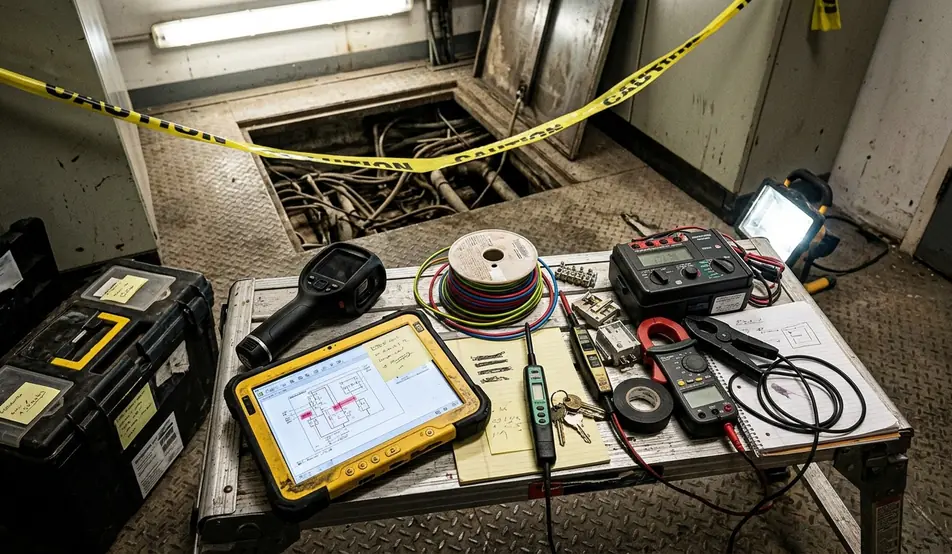
FI Needs a Date
An FI observation without a booked access or isolation date has effectively stalled. Assign the diagnostic work before routine repair planning absorbs the available shutdown windows.
Building a Repair Plan That Can Withstand Review
A defensible remedial plan connects every decision to the original EICR observation number. This preserves the chain from finding, through approval and repair, to final certification.
Move From Inspection to Controlled Work
- Register the observations. Enter each C1, C2 and FI item separately rather than creating one broad task called “EICR remedials.”
- Record immediate controls. Note isolations, restricted access and other make-safe measures against the relevant observation.
- Define the work scope. Give contractors the EICR wording, circuit references and available photographs so quotations address the coded issue.
- Approve and assign. Keep the signed work order with the selected quotation and name the person coordinating access.
- Plan verification. Decide at order stage whether the completed work will require a Minor Electrical Installation Works Certificate or an Electrical Installation Certificate.
- Reconcile the evidence. Check that the completion paperwork identifies the work that clears each original observation.
Quotes for multi-circuit commercial board work typically return in 5 to 10 working days. This procurement period should run inside the remedial programme, with C1 make-safe work already completed and urgent C2 decisions actively controlled.
Evidence That Shows Progress
Photographic records are most useful when they carry the same reference as the report. A photograph labelled only with a room name can become ambiguous once several contractors and distribution boards are involved. Linking the image, quotation and signed work order to the original observation number keeps the evidence legible.
Some duty holders initially placed every C2 and FI item into the next planned shutdown, often 8 to 12 weeks away. That approach left an Unsatisfactory certificate documenting known danger throughout the waiting period. A stronger schedule separates same-day C1 controls, C2 repair windows and FI diagnostic access.
Fit Safety Work Around Operations
Regional projects, tenant access and trading hours still shape delivery. Facility managers can group compatible work by distribution board, arrange out-of-hours isolation and align access equipment with other planned maintenance. The coded risk sets the response priority; budget cycles and convenience determine how efficiently the work is delivered within that priority.
Keep the remedial allocation visible in the facility budget. Splitting investigation, repair and certification into separate lines often makes approvals easier to trace and prevents the final verification visit from disappearing when the physical repair looks complete.
Certificates That Close the Commercial Safety Record
The physical repair closes the hazard on site. The corresponding certificate closes the evidence trail.
Choose the Certificate That Matches the Work
A Minor Electrical Installation Works Certificate, commonly abbreviated to MEIWC, is issued where the repair or alteration does not include a new circuit. An Electrical Installation Certificate, or EIC, is issued when a new circuit is installed or a distribution board is replaced.
After the final repair, the duty holder should match each original EICR observation number to the relevant MEIWC or EIC. Those certificates are then filed with the original Unsatisfactory EICR. The resulting pack shows the condition found, the action taken and the verification supplied for the completed work.
A completion certificate clears only the numbered observations it addresses. It does not change the next-inspection date printed on the original report. Completion certificates also cover the low-voltage installation as found during that process; a later change of use or added EV charging load on the same board requires its own assessment.
Run the Final Reconciliation
- List every C1, C2 and FI observation from the original report.
- Attach the relevant MEIWC, EIC or completed investigation record to each number.
- Check that circuit descriptions and locations agree across the documents.
- Resolve omissions before closing the remedial work order.
- Retain the complete pack with the installation records for future compliance & testing.
The legal endpoint is set by the Electricity at Work Regulations 1989. Regulation 29 provides a defence based on taking all reasonable steps and exercising all due diligence, yet that defence is unavailable once a documented C1 or C2 defect has been left unrepaired.