The Capacity Squeeze Across Central Scotland’s Industrial Hubs
Falkirk’s industrial connection problem starts at estate level. Applications above 1 MVA on the Falkirk and Grangemouth 11 kV networks have remained in the operator queue for 24 to 42 months before receiving a firm offer. For a tenant planning an electrified process line, that delay can outlast the commercial window behind the project.
The underlying architecture explains much of the pressure. Estate substations serving these parks commonly use 11 kV radial arrangements commissioned between the late 1980s and the mid-1990s. They were built around the demand patterns of their period: fewer high-load vehicle depots, less electric process heat and no expectation that several tenants would request substantial charging capacity at roughly the same time.
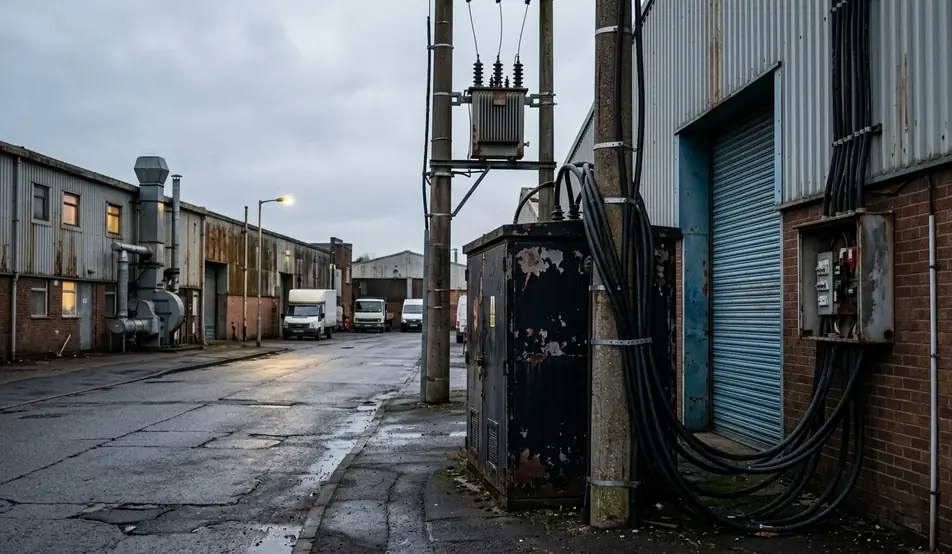
On Falkirk industrial estates, the constraint usually appears at the shared 11 kV estate transformer long before it reaches any tenant’s intake fuse. A single application for 150 kW-class depot charging can therefore restrict what every other unit connected to that board can request.
One Feeder, Several Queues
The regional distribution operator has ranked remaining headroom by application date rather than estate-wide coincident demand. Later occupiers on the same feeder inherit a queue, even where their demand could form part of a shared reinforcement programme.
This application-by-application treatment hides the relationship between neighbouring loads. A warehouse may need overnight charging, a fabrication unit may peak during the working day, and rooftop solar PV may suppress daytime import. Assessed together, those profiles can support a more useful discussion about timed access and reinforcement. Assessed separately, each tenant appears to be another claim on scarce capacity.
Shared Transformer Risk
Landlords should establish which units share an estate transformer before promising new electrical capacity in heads of terms. The service rating at one unit does not reveal the available headroom upstream.
How Connection Queues Hold Back Commercial Tenants
A fleet operator considering an 8-to-12-bay depot layout faces a difficult starting point. At around 150 kW per bay, the proposed load routinely exceeds the residual headroom of a shared industrial estate transformer. Diversity controls may reduce the simultaneous peak, although the distribution operator still needs an enforceable operating arrangement before relying on that reduction.
The Sole-Use Cost Trap
When a tenant requests depot charging or a new process line, the operator may assess that request in isolation and issue a sole-use reinforcement quote. The landlord then has to decide whether one lease can carry the cost and programme risk of an 11 kV upgrade. In many cases, it cannot.
Accepted sole-use 11 kV reinforcement quotes for individual occupiers have carried construction programmes of 14 to 26 months. That period begins after acceptance, so it sits on top of the work required to define the load, submit the application, clarify the offer and agree commercial responsibility.
- Fleet electrification: vehicle delivery dates can run ahead of energisation, leaving chargers installed without sufficient import capacity.
- Manufacturing equipment: a new process line may require an operating limit until upstream reinforcement is complete.
- Lease negotiations: landlords cannot give a dependable power commitment while the firm connection position remains unresolved.
- Compliance & testing: electrical designs may need revision when the agreed maximum import capacity changes.
The commercial consequence extends beyond one postponed project. Landlords with uncertain power availability struggle to compare prospective tenants, price electrical enabling works or set realistic occupation dates. A technically suitable unit can lose its appeal once the incoming tenant discovers that the requested capacity depends on a multi-year network programme.
Where Distribution Reinforcement Falls Out of Balance
City-centre commercial schemes in the central belt have been turning firm offers around in 6 to 12 months, while industrial loads of similar MVA can wait through two distribution planning cycles. The difference affects when land becomes usable, which projects reach an investment decision and where electrification proceeds first.
Urban mixed-use schemes often arrive with clustered planning consents and visible load growth. Investment boards can sequence those schemes as defined packages. Forth Valley industrial demand tends to arrive as separate applications from individual landlords and tenants, even where all of them depend on the same primary substation.
The N-1 Constraint Behind the Delay
Primary 33/11 kV transformers feeding Falkirk industrial land operate with tight N-1 firm capacity on plant dating from the mid-1970s to the early 1990s. N-1 planning asks whether the network can continue supplying the required demand after the loss of one significant component. A transformer may therefore carry load under normal conditions while offering little firm capacity for a new commercial connection.
This distinction matters when reviewing an apparently quiet substation or feeder. A low reading at one moment does not establish that capacity is available under outage conditions, during a different demand period or after committed connections energise.
The sequencing issue has also favoured public-facing city-centre reinforcement. Mixed-use developments entered investment discussions with grouped consents and recognisable regeneration outcomes, pushing industrial N-1 upgrades into a later capital tranche. The resulting imbalance leaves established commercial infrastructure carrying regional capacity pressure despite having active occupiers ready to invest.
Offer Dates Mislead
A firm-offer date should be recorded separately from the reinforcement completion date. Treating the offer as the end of the connection process can distort lease, procurement and commissioning programmes.
Building a Stronger Forth Valley Landlord Case
Separate connection applications rarely express the full value of reinforcing a multi-let estate. A more effective submission begins with the shared electrical system and then maps each occupier’s present and proposed demand onto it.
One regional case followed a familiar route. Landlords initially lodged applications for individual units, and each returned as a sole-use 11 kV reinforcement quote. Those proposals stalled because no single tenancy could recover the enabling cost. The landlords then commissioned a joint energy audit and presented one estate-wide capacity paper to the distribution operator.
Assemble the Estate Load Position
- Confirm the network boundary. Identify the public 11 kV feeder, estate transformers, metering points and units covered by the submission.
- Collect half-hourly demand. Use existing records to show when each occupied unit imports power and where peaks overlap.
- Record installed plant. Capture transformer nameplate ratings and the known limits of the estate’s private distribution equipment.
- Add proposed loads and generation. Set out EV charging systems, manufacturing plant and solar PV with realistic operating periods.
- Separate firm and flexible demand. Mark loads that must operate immediately and those that can accept timed, ramped or actively managed access.
- Submit one reinforcement case. Present the combined requirement, phasing and commercial trigger points to the operator.
A site-wide energy audit using half-hourly data, transformer nameplates and proposed EV and PV additions is usually completed in 4 to 7 weeks. That work gives facility managers a common baseline for connection discussions and prevents competing assumptions from reaching the operator.
Use Flexibility as an Interim Position
Joint discussions about flexible connections typically take 10 to 16 weeks from the first combined landlord meeting to a draft active-network or export-limited agreement. The proposed control may cap imports during defined network conditions, sequence charging sessions or limit solar export. Its value lies in making part of the project operable while strategic reinforcement remains under consideration.
The technical schedule needs close attention. It should identify the monitored point, control response, communications arrangement, fail-safe state and consequences of exceeding the agreed limit. Commercial tenants also need to know whether curtailment affects a convenience load, such as overnight charging, or a production-critical process.

Scope boundary: collective talks influence the reinforcement case only where several occupied units can show overlapping half-hourly demand on the same estate transformer. Vacant plots without load history leave the position unchanged. This route applies to multi-let Forth Valley industrial land supplied by the public 11 kV network; it does not map directly onto an owner-occupied site with a private 33 kV supply.
Modernising the Electrical Base of Forth Valley Industry
Regional infrastructure planning increasingly treats industrial reinforcement as a precondition for electrified manufacturing and logistics. That framing is important because solar PV and managed charging can improve how an estate uses capacity, yet neither removes the firm-rating constraint at an ageing transformer.
Plan Generation and Demand Together
Adding 200 to 500 kWp of rooftop solar PV alongside depot charging on a constrained 11 kV feeder still requires a timed or actively managed connection when the estate transformer is already near its firm rating. Solar output peaks during daylight hours, while depot charging may concentrate after vehicles return. The connection design must account for both import and export conditions rather than assuming one automatically offsets the other.
Landlords can support regional projects by maintaining a live capacity schedule for each estate. It should show current demand, accepted connection offers, planned tenancy changes, proposed generation and the date by which additional firm capacity becomes commercially necessary. This turns a series of speculative requests into a phased infrastructure proposition.
Industrial estates supply the physical base for manufacturing, storage and fleet operations across the Forth Valley. Their ability to electrify now rests on plant installed across a much earlier investment cycle. The clearest deadline is already stamped on those assets: much of the area’s electrical plant was commissioned from the mid-1970s through the early 1990s.