The Paper Trail Precedes the Panel
Why records receive first attention
A fully functional fire alarm system can still fail a compliance audit when the Responsible Person cannot produce a continuous maintenance record. Under the Regulatory Reform (Fire Safety) Order 2005, evidence matters: the file must show that the system has been tested, maintained and managed between visits.
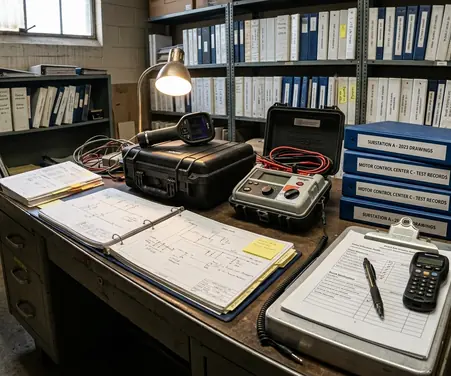
Auditors usually begin at the desk rather than the control panel. They inspect the logbook, commissioning pack, service reports and modification records before operating a manual call point. Those documents reveal whether fire safety forms part of routine premises management or receives attention only when an inspection is due.
The Responsible Person should understand the statutory duties under the Fire Safety Order and be able to retrieve the supporting records without delay.
This guide concentrates on documentation for BS 5839-1 fire detection and alarm systems serving non-domestic buildings in England, Wales and Scotland. Its scope is deliberately narrow: it examines record control rather than detector siting, alarm audibility or cause-and-effect programming.
Routine Testing and Logbook Omissions
Failure 1: Missing weekly test entries
Weekly test discipline is judged through consecutive, dated logbook entries. A blank week creates an unmanaged gap because an auditor cannot reconstruct whether the test was missed or merely left unrecorded.
Each entry should identify the date, time, person carrying out the test, device operated, alarm response and any action arising. Retrospective batches of identical entries attract scrutiny, particularly when handwriting, wording or timings suggest that several weeks were completed at once.
Failure 2: Vague fault reporting
“System fault” is not a usable maintenance record. It leaves the next person guessing which part of the commercial infrastructure was affected and whether the fault remained active.
A complete fault line should name the zone, device address or location, time identified, person notified, temporary control measures and rectification date. Where a contractor attends, cross-reference the job sheet or service report. That creates a traceable chain from detection to closure.
Failure 3: No call point rotation record
BS 5839-1 expects a different manual call point to be operated each week through a planned rotation. Record the exact call point location or device ID on the same day as the test.
Generic phrases such as “call point tested” provide no proof that the rotation covers the building. A simple schedule listing each device in sequence works well, provided the logbook records which entry in that schedule was completed. Multi-storey premises need particular care because repeatedly testing the convenient ground-floor point leaves upper floors without meaningful coverage.
Missing or Incomplete BS 5839-1 Certification
Failure 4: Absent commissioning certificates
The original design, installation and commissioning certificates establish the system baseline. Without them, an auditor has no fixed reference for the category, agreed variations, device coverage or configuration accepted when the system entered service.
Search beyond the current maintenance folder. Older certificates may sit with project handover documents, building-control records, landlord files or fit-out information. Once recovered, store the complete pack together and record where the signed originals are held. If documents cannot be found, commissioning history must be reconstructed formally rather than filled with assumptions.
Failure 5: Undocumented system modifications
Office fit-outs routinely disturb fire alarm coverage. Partitions move, rooms change use, ceilings are altered and detectors are relocated to suit a revised floor plate. The physical work may appear minor, yet it changes the certified arrangement.
A formal modification certificate should be obtained and filed within the same service cycle as the work. The certificate needs to connect the changed devices with the current drawings, zone plan and system records. Purchase orders and contractor invoices show that work was commissioned; they do not demonstrate BS 5839-1 compliance.
Failure 6: Missing acceptance certificates
Commissioning and acceptance perform different jobs. The commissioning documents record technical verification, while the signed acceptance certificate confirms that premises management received the system, documentation, instructions and operating information.
Handover remains incomplete until that acceptance record is retained with the commissioning pack. This gap often appears after a change of managing agent or facilities team, when technical certificates transfer but the management sign-off does not.
Zone Plans and False Alarm Management
Failure 7: An outdated or missing zone plan
The zone plan beside the control and indicating equipment must match the building that emergency crews will enter. If a tenant has divided a floor, changed access routes or renumbered rooms, an old plan can direct responders to the wrong area.
Check the plan against the panel zone text and the current floor layout. It should remain legible, fixed adjacent to the panel and oriented clearly enough for someone unfamiliar with the premises to use under pressure. Spatial accuracy becomes more important in multi-storey and multi-tenant buildings where fire-service approach routes differ by floor plate.
Failure 8: Uninvestigated false alarms
Every false alarm needs a log entry identifying its cause category and the preventative action taken. Record the event when the panel is reset, then update the entry when the investigation or corrective work closes.
Repeated alarms from cooking fumes, dust, steam or a poorly positioned detector indicate a management issue. Silencing the panel and carrying on encourages desensitisation among occupants. The record should show who investigated, which device initiated the event and what reduced the chance of recurrence.
Failure 9: Gaps in six-monthly servicing records
Keep comprehensive inspection reports from a competent contractor for the installed life of the system. Each report should identify the premises, system, devices or areas examined, defects found, work completed and outstanding recommendations.
Watch the gap between a service report and the evidence that its defects were resolved. An invoice marked “paid” does not close a technical defect. Link every remedial visit to the original finding so an auditor can follow the sequence without interpreting scattered emails.
Structuring an Audit-Proof Record System
Use one live record and one secure archive
A panel-side logbook remains the practical place for weekly tests, activations and immediate fault entries. Historic certificates and service reports need stronger protection, especially across regional projects or premises with frequent management changes.
The most dependable arrangement uses both:
- Keep the physical logbook at the control panel. Staff can enter tests and incidents immediately, and an auditor can inspect the current sequence without waiting for system access.
- Mirror formal records to a permission-controlled digital folder. Store design, installation, commissioning, acceptance and modification certificates alongside service reports and closed remedial records.
- Use a consistent file name. Include the site, document type, relevant system area and issue date so records sort predictably.
- Review the archive periodically. Compare digital files with the panel logbook and chase missing contractor reports before they become historic gaps.
- Assign named deputies. Roster specific on-site personnel for logbook upkeep rather than leaving responsibility with whoever happens to stand nearest the panel.
Facility teams often retain this dual arrangement after multi-site reviews expose repeated difficulty retrieving older certificates. It keeps immediate entries close to the equipment while protecting the long-term compliance record from loss or casual removal.
Digital access must remain available to the Responsible Person during an unannounced visit. A cloud-only folder controlled through off-site credentials can delay retrieval and still produce a documentation finding. Test access from the premises and keep a clear recovery route for locked accounts.
The Non-Negotiable Standard for Facility Managers
Make documentation part of system operation
Fire alarm records should function as continuous operational control. Waiting for audit day invites missing signatures, unresolved faults and certificates that nobody can locate. Liability follows the absence of proof as readily as a failed device test.
My recommendation is firm: maintain the live logbook at the panel and back it with a permission-controlled digital archive containing every certificate, weekly test trail and six-monthly service report. Adopt that dual system as the minimum standard for protecting occupants and the business.