The Challenge of Shared Commercial Supplies
How do you accurately divide a single incoming electrical supply among multiple commercial tenants without triggering billing disputes?
That question becomes awkward in multi-let high-street and business-park properties where the building still has one DNO MPAN. Historically, landlords divided the electricity bill by net internal area. The calculation was simple, yet it ignored what happened behind each tenant’s door.
Consider a food-preparation unit beside two professional-services suites in a typical layout. The kitchen carries refrigeration and cooking loads throughout the day, while the offices may run little more than lighting and desktop equipment. An area-based split can leave those low-load occupiers underwriting the kitchen. During recent letting cycles, that mismatch made NIA-based recharges increasingly difficult to defend at rent review.
A typical small multi-let intake in Scotland falls between 100 A and 400 A, three-phase at 400 V. The incoming capacity says little about how individual tenants use it. Measured kWh provides the defensible basis: each demise pays for its recorded consumption, while shared services receive separate treatment.
Recharge Fault Line
Estimated billing creates friction because tenants can compare the recharge with their operating pattern. A monthly statement should trace cleanly from an opening meter value to a closing value, usually within the 10-to-14-day issue window after month-end.
The practical objective is straightforward. Establish a meter boundary for every tenant, define the landlord loads, and preserve readings that can be reproduced when a tenant challenges an invoice.
When Tenant Billing Requires an Approved Meter
The hardware decision belongs in the specification. If an electricity reading will appear on a third-party recharge, use a meter approved for active electrical energy under MID or the applicable successor UKCA regime. The meter’s location in a landlord switchroom does not determine the requirement; the intended use of its reading does.
Official guidance on MID-approved electricity meters should be checked when preparing the meter schedule. For tenant recharge, MID Class B active-energy meters are the usual choice. Class A is treated as too coarse for financial settlement.
Check-Meter or Billing Meter?
- Internal check-meter: Used by the facilities team to observe plant performance, identify abnormal consumption, or compare an air-handling unit with its expected load.
- Tenant billing meter: Supplies kWh figures used to calculate money owed by a third party and therefore needs the relevant approval.
A plant-room check-meter serving an AHU can remain non-approved when its figures never enter a recharge. The same hardware becomes unsuitable when its totals are copied into a tenant invoice.
Non-approved meters often become visible during the first or second quarterly reconciliation, when a tenant compares the recharge with process-load estimates. At that point, calibration discussions rarely solve the underlying problem: the billing record came from hardware that was never specified for the transaction.
Sizing and Installing Current Transformers
CT selection starts with the protective device on the tenant way. A 100 A fused supply generally calls for a 100/5 CT; a 200 A MCCB calls for a 200/5 CT. This places maximum demand toward the useful upper part of the CT range without driving the transformer into saturation.
I have seen an 800/5 set proposed for a 63 A tenant way simply because the parts were available. Overnight demand sat so low on the CT curve that the meter registered near-zero consumption. Replacing it with a 100/5 set produced a far more credible record. This is one section of the design where spare stock should never dictate the ratio.
Lock the Ratio Twice
The physical CT ratio and the ratio programmed into the meter must match. If the 200/5 CTs are installed while the meter is configured for the 400/5 ratio, every recorded tenant kWh is doubled on the recharge invoice. The arithmetic may look consistent from month to month, which makes the error particularly easy to miss.
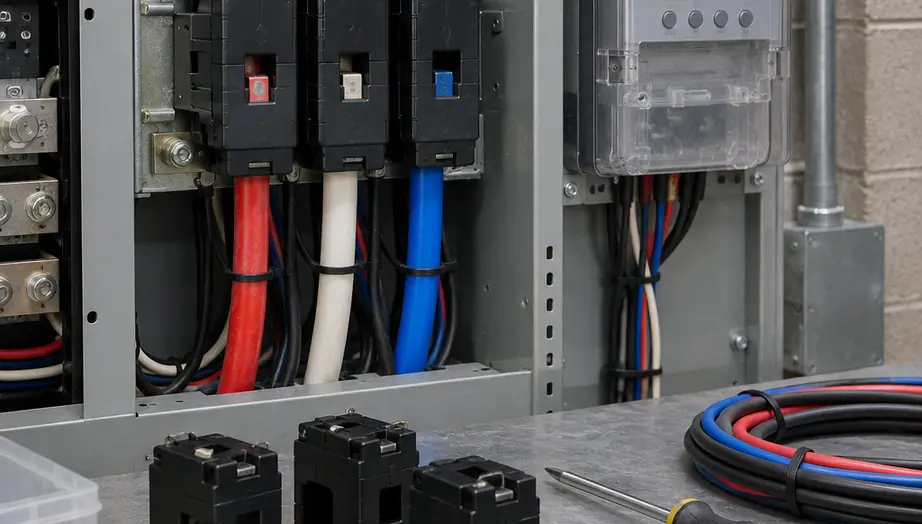
CT Installation Sequence
- Confirm the tenant protective device rating and expected maximum demand before ordering the CT set.
- Install each CT with P1 facing the supply and P2 facing the load. Reversed polarity inverts the power sign and can credit the tenant where reverse energy is not suppressed.
- Run the secondary wiring in 2.5 mm² conductors, or the size required by the meter manufacturer, without intermediate joints.
- Terminate through the specified shorting arrangement so the CT secondary can be made safe during meter work.
- Label every core, shorting block, meter terminal, tenant demise and CT ratio before closing the distribution board.
- Verify the programmed ratio, phase association and direction of power under a known live load.
Shutdown Constraint
Where isolation of the incoming tails would force a shutdown across a full occupied working day, split-core CTs remain the practical retrofit choice. Access and polarity still need the same discipline as a solid-core installation.
Logging Usage and Separating Landlord Loads
A correct meter installation can still produce a weak recharge file if somebody records one number during a monthly walk-round. Remote logging adds the time dimension needed to explain occupancy changes, unusual peaks and disputed billing periods.
For commercial infrastructure, Modbus RTU over RS-485 is the useful baseline. Each poll can return kWh, kVArh, voltage, current and power factor. Pulse outputs provide accumulated energy counts, but they cannot populate the same detailed dispute record for the landlord suite.
Configure the Logging Chain
- Give every meter a unique bus address and record it against the tenant demise.
- Run the RS-485 bus at the selected common setting, often 9600 baud.
- Poll at 15-minute or 30-minute intervals to align records with UK settlement periods.
- Synchronise the logger clock to UK local time using an NTP or GPS source.
- Check the BST and GMT changeovers so timestamps remain ordered and recharge periods do not overlap.
Recharge statements can then show an opening timestamp, closing timestamp and measured kWh for the calendar month. Facility managers also retain the underlying interval record instead of relying on a transcribed notebook entry.
Keep Shared Loads Visible
Corridor lighting, external security and landlord HVAC need their own accounting boundary. Put those circuits on a dedicated landlord MID meter when they are being recovered through a defined recharge mechanism, or leave them on the incoming MPAN for treatment through the landlord account.
Never derive shared consumption by prorating figures from tenant CTs. That approach obscures losses and unmetered landlord circuits, then pushes the unexplained balance into tenant statements. A separate landlord channel makes the reconciliation readable: incoming energy can be compared with tenant totals and recorded common-area demand.
Clock Integrity
A logger with the wrong clock can assign sound meter data to the wrong billing period. Confirm time synchronisation during commissioning and after any communications outage.
Build the Metering Network for the Next Load
Manual reads look economical in a two-tenant building because the monthly walk takes only a few minutes. The hidden work follows: arranging access, transcribing values, checking missing reads and explaining consumption changes that happened between visits.
A networked logger starts delivering operational value immediately. Automated 15-minute or 30-minute records remove transcription errors, reduce recharge administration and give both parties a timestamped trail when a bill is questioned. Installing communications later requires a return visit to every meter and creates an awkward period where manual and automatic records overlap.
The same RS-485 or Ethernet backbone can accept additional MID meters as regional projects evolve. Future 7 kW to 22 kW AC EV charging systems can receive dedicated channels, while a landlord solar PV incomer can be added without replacing the original tenant meters.
Install the networked logger and communications path during the first sub-metering installation, even in a building with only two tenants.