
Why Charging Staff for Workplace Electricity Is the Only Way to Keep Bays Open
Commercial landlords and employers should charge staff for every kilowatt-hour dispensed on site if they want a functional workplace EV network. Recover private charging costs from drivers, account for fleet energy internally, and keep the bays moving. Free electricity encourages employees to use scarce commercial infrastructure as their everyday refuelling depot.
The problem starts before the office fills. Drivers arrive, connect and leave their vehicles for the working day. Even employees with access to inexpensive overnight home tariffs have little reason to use them when workplace electricity costs nothing.
Across commercial sites in Scotland and the wider UK, the operational pinch point is familiar: both outlets on a dual-socket bollard serve vehicles that have finished charging, while a visiting client or field engineer waits for access.
A Finished Session Still Occupies a Bay
A charger dashboard can show available electrical capacity while the car park has no usable charging spaces. That distinction matters. Installing another bollard may add capacity without fixing turnover, particularly where the same employees claim the nearest spaces each morning.
I would judge the arrangement by whether a working vehicle can obtain a useful charge during its visit. Electricity dispensed is only part of that test.
Protect Bay Turnover
A kWh tariff addresses energy consumption. A separate occupancy rule addresses the vehicle left behind after charging finishes. A workable policy needs both.
Explain that distinction when announcing paid charging. Staff can reasonably question the price of electricity; they should also understand why an occupied, inactive bay disrupts field operations. The practical objective is access throughout the day, rather than a full row of connected cars at opening time.
Morning Peak Load Spikes and the Tax Traps of Unmetered Sockets
Morning charging competes with the building itself. HVAC plant starts, lighting comes on, and the EV bank begins drawing power from the same incoming supply. A tariff may influence demand, but electrical protection must work even when every permitted driver plugs in together.
Keep Tariffs Separate From Load Protection
Compare the site's measured demand with its agreed Maximum Import Capacity (MIC), the incoming equipment ratings and the capacity available to the EV distribution board. These are separate constraints. Exceeding an agreed import limit and overloading a protective device have different consequences.
Without effective dynamic load management (DLM), simultaneous charging can exhaust available headroom. Depending on the installation, that can lead to protective-device operation or bring forward a costly Distribution Network Operator (DNO) supply upgrade. A higher import agreement alone does not increase the rating of the switchgear.
Configure DLM to curtail charging against the relevant supply constraint. Check current-transformer placement, phase mapping and the response to lost communications. Price signals help manage demand; the controller must enforce the electrical ceiling.
Protect The Incomer
Test curtailment while building demand changes. A dashboard showing a configured limit gives less assurance than a witnessed reduction in charger output.
Separate Tax Treatment From Billing Records
Free workplace charging does not automatically create a taxable Benefit-in-Kind (BiK) for a privately owned vehicle. HMRC provides an exemption for qualifying workplace charging, subject to conditions including where charging is provided and its availability to employees generally. Company-car electricity has its own treatment, so a single rule applied to every vehicle can mislead payroll.
The HMRC Employment Income Manual guidance on workplace electric vehicle charging sets out the relevant distinctions. Check the actual arrangement against those conditions before describing a benefit as taxable or exempt.
Keep private staff, visitor and company-fleet sessions identifiable in the back office. An unmetered socket cannot provide a defensible consumption breakdown. Missing records complicate cost allocation and tax review, even where an exemption applies.
Structuring Cost-Recovery Tariffs and Overstay Penalties
Build the replacement around a contract-linked kWh rate and an automated overstay charge. A flat annual staff rate offers predictability, but leaves the landlord exposed when the commercial electricity contract changes. A published review mechanism makes that exposure easier to control.
Give Each Charge a Clear Job
- Recover electricity costs. Tie the energy rate to the current commercial supply contract. State whether the calculation includes VAT, payment processing or an allocated share of other costs. Describe a blended rate accurately rather than calling every component the electricity unit price.
- Allow time to move. Start a clearly advertised grace period when charging genuinely finishes. Make sure notifications reach drivers and distinguish completion from temporary load curtailment or a communications fault.
- Price prolonged occupation firmly. Apply a prominent per-minute overstay charge after the grace period. Make it consequential enough to encourage lunchtime turnover, with clear terms and a correction route for charger faults.
The trigger deserves particular care. An OCPP status change to suspended can reflect vehicle behaviour or a site-imposed limit. Charging software must interpret those states correctly before it starts an idle-fee clock. Test the complete billing sequence with real vehicles.
Separate Fleet Tokens From Personal Charging
In an OCPP-capable back office, assign fleet RFID tokens to an account group that attracts no driver payment while retaining metered session records for departmental recharging. Assign private staff vehicles and visitors to the standard paid group. Confirm that the selected platform supports these tariff rules; OCPP connectivity alone does not supply a complete billing service.
Fleet electricity still carries a cost. Recovering it through a departmental cost centre preserves operational access without disguising consumption as free energy.
Before enabling monetary kWh billing, require suitable metering, including an MID-certified register where applicable, and a session record tied to the account or token. Check the proposed billing arrangement against the applicable metering requirements. A tariff notice cannot repair an unsuitable meter.
Rolling Out Paid Charging Without Stalling Fleet Electrification
Sequence the change around communications, load control and driver access. Publishing prices before proving those systems creates avoidable disputes on the first billed morning.
Prove the Equipment Before Publishing Prices
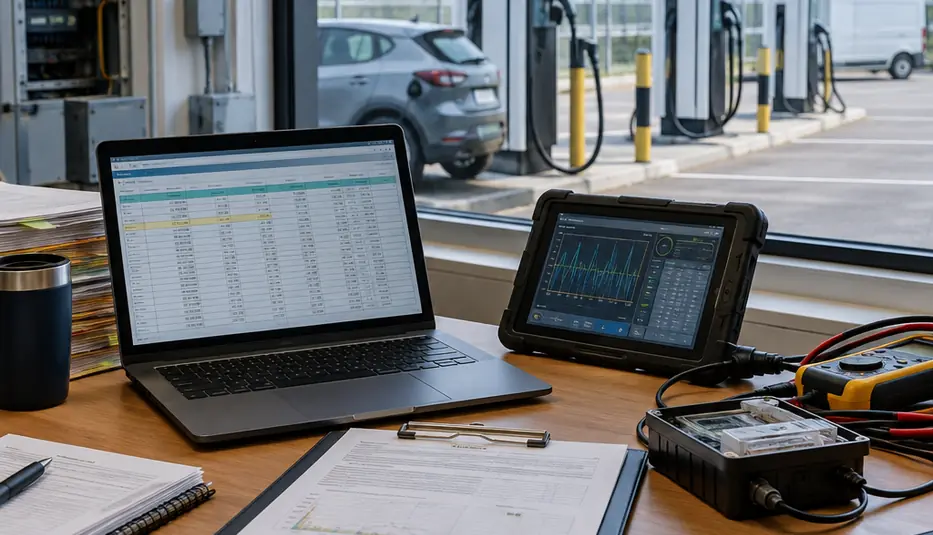
- Inventory every AC pedestal. Record its model, firmware, meter, OCPP support and back-office reachability. Confirm that remote commands, session records and tariff functions work on the installed equipment.
- Test the actual data connection. Check sustained connectivity beside chargers in basement and steel-framed car parks. Where cellular service drops, arrange a dependable alternative, such as cabled backhaul, before relying on online billing.
- Prove the CT-clamp integration. Use a controlled load change to verify measured current and charger curtailment. Include communications-loss behaviour in the commissioning record.
- Run representative billing sessions. Check staff payment, visitor access, fleet cost-centre allocation, completion notifications and overstay handling. Resolve failed sessions before the public cutover.
For regional projects, keep the acceptance checklist consistent while recording each site's supply limits and communications arrangements separately. A successful configuration at one car park cannot establish the available capacity at another.
Make the Parking Rules Match the Software
Publish the energy rate, grace period, overstay charge and fault-reporting route together. Put the same terms at the charger and in the payment journey. Choose a cutover that leaves staff available to resolve access problems, rather than combining the launch with a difficult heating-season peak.
Set a four-hour maximum window on standard 7 kW–22 kW AC posts, with a defined process for operational exceptions. Reserve rapid-turnaround bays for commercial vehicles, and check that their charger output suits the required turnaround. Signs alone cannot create a rapid charge.
Which bays will you reserve for field engineers before the first paid staff session begins?