Statutory duties survive the repairing covenant
Under the Health and Safety at Work etc. Act 1974 and the Electricity at Work Regulations 1989 (EAWR), electrical safety duties cannot be contracted out through a Scottish commercial lease. A full repairing covenant may settle who pays for a replacement distribution board. It cannot leave an unsafe board in service while landlord and tenant argue over the invoice.
EAWR Regulations 3 and 4 place duties on people according to their work and the control they exercise over an electrical system. In a let building, that can include both the property owner controlling the incoming supply and the occupying employer using the installation. Each must prevent danger within the system they control. Signing the lease does not transfer every statutory duty to the tenant.
I read the repairing clause alongside the electrical layout. Where the lease places maintenance costs on the occupier but the landlord retains the riser and main switchgear, those documents describe different things: payment on one hand, physical control on the other. Both matter when arranging inspection, isolation and repairs.
Where a Scottish FRI lease meets the isolator
A full repairing and insuring (FRI) lease usually makes the tenant responsible for maintaining the electrical installation within the demised premises. The difficult word is within. A coloured line on the lease plan may follow a partition while the cables serving the unit still run through a landlord-controlled riser.
Trace the supply from the main incomer through the meter, distribution board and sub-main to the first isolator dedicated solely to the unit. In a typical arrangement, the tenant’s fixed-wiring responsibility begins at the load terminals of the landlord’s incoming meter or at that labelled sub-main isolator. The lease maintenance clause should identify the chosen point and say who maintains the equipment on either side. Record who can arrange an outage to work on it.
The managing agent may commission an EICR for the landlord’s risers and main incomer and keep the reports. That coordination does not make the agent the sole duty holder. Control of the relevant installation, read with the lease’s maintenance clauses, remains the question for landlord and occupier.
The boundary worth recording
Put three layers on one marked-up schematic: the landlord riser, the tenant sub-main and the equipment inside the unit. Then match each layer to its maintenance owner, authorised isolator and inspection record. This catches an awkward gap: a tenant may pay to repair wiring it cannot safely isolate without the landlord’s access arrangements.
Shared plant rooms need controlled switching
Multi-tenanted buildings concentrate the sharpest boundary problems in plant rooms. A main distribution board may supply several units; one tenant’s sub-main can pass through a space that tenant cannot enter alone. Keys, switching authority and shutdown notice therefore belong in the operating procedure, not just the lease.
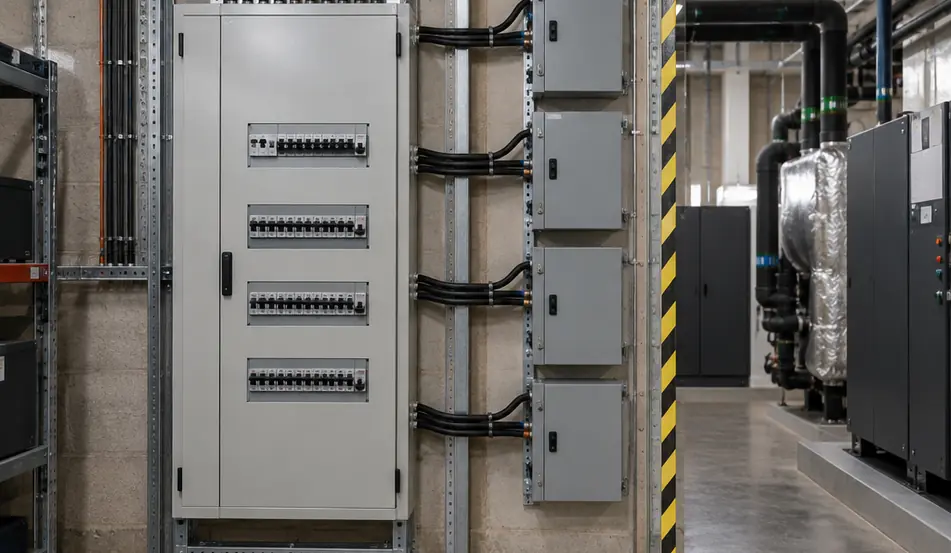
Keep plant-room and heavy-switchgear keys on a landlord or managing-agent register. A tenant-appointed contractor should work downstream of the tagged isolator for that tenant’s sub-main. Display a numbered schematic at the board so the contractor can identify the correct circuit without opening shared main switchgear.
For planned isolation of shared switchgear, allow an approximately 5 to 10 working-day notice window to other occupiers. An emergency trip needs an immediate response rather than a planned-shutdown timetable. Write down who authorises switching in each case, who operates the gear and how affected occupiers are told the supply is safe to restore.
Plant-Room Keys: A shared key-safe gives access to the room, but it does not establish authority to operate the main incomer. Keep that authority on a named register and use a permit-to-isolate for work affecting shared supplies.
What an insurer or HSE inspector can verify
After an incident, a policy folder offers little help if it cannot show what condition the installation was in and what happened to identified defects. Keep the current Electrical Installation Condition Report (EICR), earlier reports needed to trace recurring observations, a continuous maintenance log and signed evidence that remedial work was completed. File certificates against the original observation numbers.
An EICR is a condition record, not a substitute for repairs. A C1 observation calls for the inspector to make the danger safe before leaving site. For a C2 observation, record the repair programme, completion and verification in writing. An open C2 followed by an unsigned note saying “done” leaves the person reviewing the file unable to establish that the danger was removed.
Check the next inspection date against the last report and the installation’s use. The normal maximum interval cited in IET Guidance Note 3 is five years for commercial installations and three years for many industrial units; a shorter recommendation on the report takes precedence. These intervals do not settle the condition of a heavily altered board between inspections.
Keep evidence of contractor competence with the work records: current SELECT or equivalent registration recognised in Scotland, plus the named electrician’s qualifications for the voltage and equipment involved. This lets an insurer or HSE enforcement officer connect each inspection, repair and switching operation to the person who carried it out.
C2 Close-Out: Retain the original observation, the remedial certificate and written verification together. A fresh cover sheet alone does not show which defect was fixed.
A light industrial unit handover, from report to tag
Consider a new tenant taking a single-occupancy light industrial unit supplied by one sub-main from a landlord board. The lease places wiring inside the unit on the tenant and leaves the riser and main board with the landlord. Here is the handover sequence to put into the entry schedule.
- Before the lease starts, close the defects. Arrange for the incoming tenant’s electrical contractor to review the landlord’s latest EICR nearly 10 to 15 working days before entry. Match every C1 and C2 observation to its remedial certificate and written close-out. If one remains open, require the landlord to make it safe and provide the record before the tenant takes occupation.
- At entry, mark the physical boundary. Walk the supply with the landlord’s facilities team. Confirm the dedicated sub-main isolator against the plant-room schematic, lock-tag it and record its identifier on a duplicate tag schedule held by both parties. State that the landlord controls switching upstream and the tenant’s contractor works downstream under the agreed isolation procedure.
- Start the tenant’s maintenance record. The tenant’s internal duty holder files the EICR and tag schedule, begins written visual checks of fixed wiring and sets a portable appliance testing schedule: just about 12 months for workshop tools and in the range of 24 months for IT equipment in the dry office area. Log any damaged lead or altered circuit as it arises, with the action taken and the person who completed it.
On the first working day, the tenant can point to a closed-out EICR, a tagged isolator and a live maintenance log. The landlord can point to the same boundary on its board schematic and identify who may switch the shared supply.