Navigating Shared Electrical Risks in Commercial Hubs
Who is legally responsible when a tenant’s faulty appliance trips the main breaker of a shared commercial office block? The starting point is practical control. Under the Electricity at Work Regulations 1989, duties attach to the party controlling the relevant electrical system or equipment rather than automatically following ownership of the freehold.
That distinction matters in multi-tenant commercial infrastructure. A tenant appliance connected to a shared final circuit can open the main breaker, interrupting communal lighting and fire-alarm supplies fed from the same board. The operational effect may spread across the building even though the defective item belongs to one occupier.
Map Control From the Plug Backwards
A useful site exercise begins with every load capable of affecting the main distribution. The facilities team records who plugs in the item, who can isolate it and who controls access for inspection. Communal risers, incoming switchgear and landlord sockets remain within the landlord-controlled system. At a tenant socket outlet, responsibility normally passes to the occupier for equipment connected downstream.
Breaker-Control Check
Do not use the distribution board boundary as the only test of responsibility. Record both the electrical connection and the party with day-to-day control of the appliance.
A blanket annual PAT visit obscures this division. It consumes testing time on stable, low-risk office equipment while treating heavily handled kitchen and cleaning appliances as though they present the same conditions. A defensible schedule follows the asset’s construction, environment and use.
Moving to IET Risk-Based Inspection Intervals
The IET Code of Practice for In-service Inspection and Testing of Electrical Equipment, 5th edition published in 2020, supports per-asset intervals instead of one building-wide anniversary date.
Apply the Factors in a Fixed Order
- Record the construction class. Identify Class I equipment that depends on a protective conductor and Class II equipment that uses double or reinforced insulation.
- Assess the environment. Note wet areas, harsh handling, cleaning activity and shared access. Separate these from dry, supervised office locations.
- Consider user competence. Distinguish ordinary office users from trained cleaners or other staff who regularly handle portable equipment and can perform defined visual checks.
- Set and justify the interval. Enter the resulting inspection and test frequency against the asset group in the written scheme.
Class I metal-cased appliances used in a wet communal kitchen commonly sit on a 12-month combined inspection and test cycle. Class II IT equipment in a dry, supervised office may extend to 48 months. Those periods follow different exposure profiles, despite both types of equipment occupying the same address.
The compliance trail should record the equipment class, environment, user competence and selected interval for every group. A date alone cannot explain why the decision was reasonable.
Interval Constraint
The 48-month IT interval assumes dry office conditions and competent office users.
Drawing Landlord and Tenant Equipment Boundaries
Clear demarcation is easiest to establish during a joint walk-round using floor plans and lease demise drawings. Mark each appliance according to location, ownership and practical control, then reconcile that mark-up with the testing registers.
Items Kept on the Landlord Register
- Communal kitchen white goods supplied for shared use.
- Lobby floor buffers and other common-area cleaning equipment.
- Reception kettles or similar appliances supplied with the building.
- Fixed building infrastructure up to each tenant socket outlet.
Items Assigned to the Tenant
- Specialised office equipment brought into the demise.
- Bring-your-own-device chargers.
- Private kitchenette kettles, toasters and similar appliances.
- Server-rack equipment and its connected power distribution units.
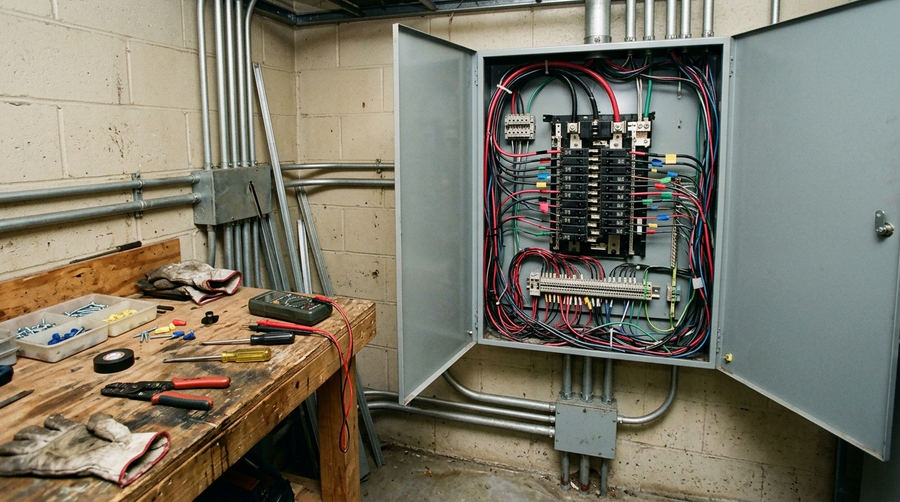
The landlord PAT register therefore stops at the tenant server-rack PDU even when that rack shares the floor distribution board with landlord-supplied reception computers. The shared upstream board does not transfer day-to-day control of the rack.
Close the Lease Access Gap
A lease that says nothing about electrical equipment maintenance can leave the landlord without a contractual right to test tenant equipment, including an appliance that has already opened a shared breaker. The site procedure should state who maintains tenant kit, how evidence is supplied and when access must be provided following an electrical incident.
Building the Appliance Register and ID Labels
Inventory work should proceed by control group rather than by collecting sticker dates floor by floor. For a three-storey multi-tenant block, a complete walk-down can be carried out in the ballpark of 3 to 5 days when current floor plans and lease demise drawings are available before the first visit.
Capture Each Asset Step by Step
- Walk every communal area and tenant demise covered by the agreed scope.
- Assign a unique asset ID and record the physical location.
- Identify the demise as landlord-controlled or name the responsible tenant.
- Record construction class, environment and user type.
- Group equipment with the same duty and risk profile.
- Enter the inspection interval, last-test date, register-only next-due date and a one-line justification.
The physical label should carry the unique ID only. A printed next-test-due date goes stale the day a meeting-suite kettle is rehomed into the shared kitchen. With a central digital register, the facilities team changes the location, risk profile and interval without replacing the sticker.
Use Staff Checks Between Formal Visits
High-use communal items need visual attention during the months between combined inspection and test visits. Staff checks should look for damaged plugs, split flexes, loose cable entry points, heat marks and casings affected by impact. The checker records the asset ID and removes suspect equipment from use through the site’s isolation procedure.
These checks work best when they appear as scheduled tasks against named communal asset groups. An informal instruction to “keep an eye on the kettles” leaves no usable compliance & testing record.
Worked Schedule for a Three-Storey Office Block
Consider a three-storey block with shared kitchens, a communal reception, landlord cleaning equipment and tenant server rooms. The schedule groups assets by location, duty and control rather than assigning one PAT date to each floor.
Apply the Schedule
- Register the shared kitchen kettles. Mark each as landlord-controlled, record its unique ID, Class I construction where applicable, wet communal environment and daily shared use. Set a 12-month formal combined inspection and test, with a staff visual check every month.
- Add the cleaner’s vacuum. Place it in the heavy-use communal group because trained cleaning staff handle and move it throughout the building. Apply the same 12-month formal cycle and monthly visual checks.
- Record reception IT. Enter the landlord-supplied computers and related equipment as operating in a dry, supervised office. Set a 48-month formal combined inspection and test while those conditions remain unchanged.
- Exclude tenant server racks. Name the controlling tenant in the demarcation record, stop the landlord register at the tenant server-rack PDU and retain the tenant’s maintenance obligation in the access procedure.
- Complete the audit fields. For every included item, enter the unique ID, demise, location, construction class, environment, interval, last-test date and one-line justification. Keep the next-due date in the digital register only.
- Process a location change. If reception IT moves into the cleaner’s store, update its environment immediately, remove the 48-month interval and place it on the 12-month communal cycle. The asset keeps its original ID while the register calculates the revised due date.