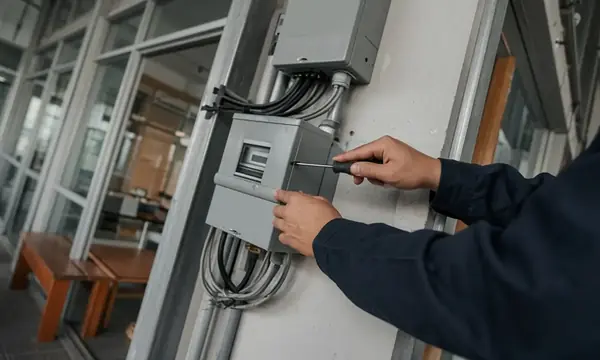
The Proactive Case for Three-Phase Power
A pre-emptive three-phase upgrade can be one of the highest-yield infrastructure investments available to the owner of an ageing commercial unit. The decision usually takes shape in an asset-management meeting, where the valuer compares a three-phase unit with the single-phase shed next door. At that point, limited electrical capacity becomes a listing defect rather than a future tenant’s problem.
The traditional approach leaves the upgrade until an occupier requests more power. That creates an awkward negotiation over contribution, lease length and reinstatement. It also places disruptive DNO work inside a live tenancy, when isolation and trench access are harder to arrange.
Use the void period
A void lasting 6–11 weeks provides the practical opening for DNO isolation, trenching and board changeover without interrupting rent. The work can be coded as a capital item alongside the next refurbishment, with its sequence agreed before decorators, floor contractors or racking installers occupy the site.
Capacity Changes Value
Securing three-phase capacity moves an older unit beyond basic storage use. It can then support commercial heat pumps, advanced HVAC, production equipment and EV charging systems, giving valuers a stronger basis for positioning it as future-ready commercial infrastructure.
This change affects the viewing conversation immediately. Prospective tenants can discuss their operating load and expansion plans without first asking whether the incoming supply makes the building unusable.
Where a 100 A Supply Reaches Its Limit
Many industrial units built on Scottish and English estates during the 1970s and 1980s still have a 100 A, 230 V single-phase incoming service. After diversity, that provides roughly 23 kVA. A quiet warehouse may appear electrically adequate because its previous occupier ran little more than lighting, sockets and a small office.
Historical consumption gives a poor picture when the next use includes electrically driven heating or fleet charging. The load schedule has to be rewritten around the proposed plant.
Heat, ventilation and process load
A commercial air-source heat pump in the 30–45 kW range cannot start on this incoming service without a severe voltage dip. Advanced HVAC controls, fans, pumps and workshop equipment compound the problem. Some loads run continuously; others impose a sharp starting demand that exposes weaknesses hidden by an apparently modest annual consumption figure.
EV charging creates the hard stop
A 7.4 kW charger already takes a material share of a single-phase supply. Once heat-pump inrush shares the board with any AC charger above that level, the 100 A and 23 kVA ceiling becomes a hard stop. Fleet briefs have also made 22 kW AC charging a common requirement for logistics and service vehicles.
With HVAC operating, one 22 kW charger can trip a shared 100 A single-phase board. Load management may control charging for a limited deployment, but it cannot create upstream capacity for heat, process equipment and a growing fleet.
Building a Defensible Upgrade Budget
Three-phase upgrade costing should begin with the DNO preliminary enquiry. Starting with an internal electrical quotation risks producing a precise price for a board that the local network cannot yet supply.
Price the work in network order
- DNO connection: Establish whether the existing feeder and substation have sufficient headroom for the requested capacity.
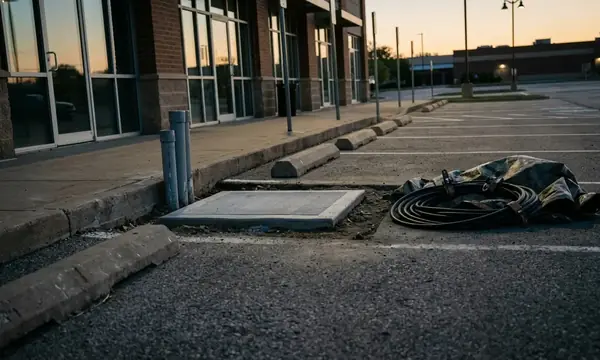
- Estate-road and site trenching: Measure the route from the estate boundary to the unit riser in linear metres, following any usable duct route.
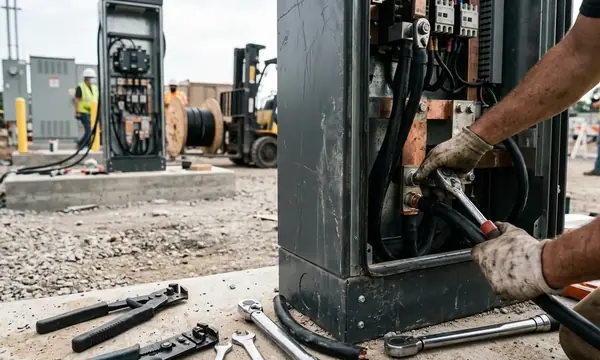
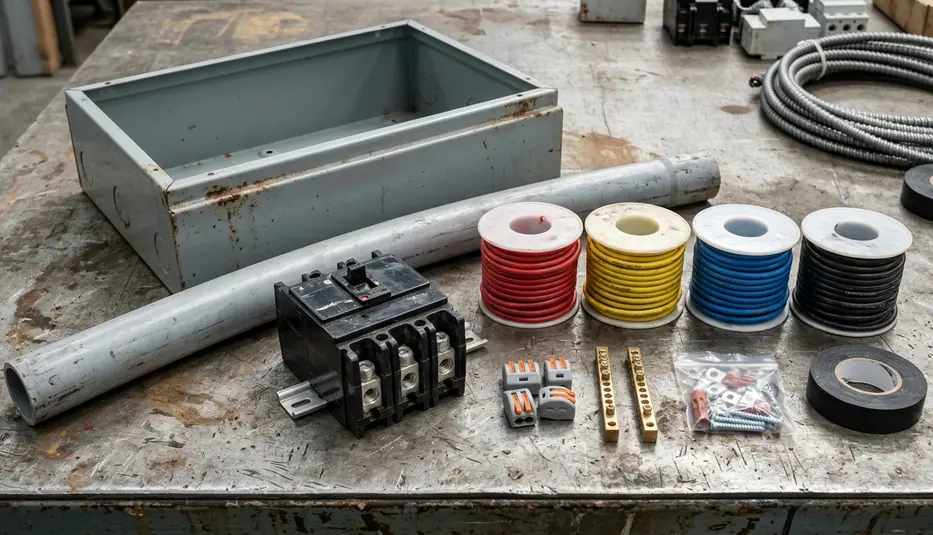
- 400 V switchgear: Specify equipment with the required rating, protection and isolation arrangement.
- Three-phase distribution board: Design outgoing circuits around the assessed load schedule and suitable phase balancing.
- Final equipment connections: Install charger tails and plant supplies only after the upstream arrangement has been confirmed.
The physical order matters: DNO cut-out, estate-road trench, 400 V switchgear, distribution board and then charger tails. A board-first programme can leave new equipment idle while the property waits for network work.
Separate DNO and customer-side costs
The unmetered element generally covers the DNO-controlled network up to the cut-out. Metered works begin on the customer side and include the metering arrangement, switchgear, distribution and final circuits. Responsibilities must be marked clearly in the scope so that cut-out changes, meter coordination and internal isolation do not disappear between quotations.
A DNO budget estimate following a preliminary enquiry typically takes 8–12 weeks. On a constrained network, a formal connection offer may extend into a 4–9 month window. Once the incoming service is live, internal changeover to 400 V switchgear and a new three-phase distribution board commonly requires a 2–4 day isolation.
Feeder Before Floor Area
DNO charges depend heavily on the distance to the connection point and available local grid capacity. Reinforcement cannot be priced until the DNO confirms headroom at the specific substation; unit size and the existing fuse rating do not provide a substitute.
Testing the Return Through Rent and Retention
The commercial return starts with the prospective tenant pool. Light-industrial operators, last-mile logistics businesses and small-batch manufacturers increasingly treat a 400 V incoming supply as a go-or-no-go question at the viewing stage. A unit that fails that test may never reach detailed lease negotiation.
Model the property, not just the installation
The useful comparison sets the achievable three-phase rent against the complete DNO, trenching, switchgear and distribution-board outlay. The model should include the timing of a planned void and any avoided rent interruption. It should also test the value of reaching occupiers who would reject a single-phase building outright.
- Record the current passing rent and realistic rent for a comparable three-phase unit on the same estate.
- Add every enabling cost, including excavation, reinstatement, metering coordination and isolation.
- Model whether the improved rent and reduced void exposure recover the capital outlay within the owner’s holding period.
- Test whether the proposed capacity supports a second 22 kW charger alongside the intended process load.
Retention deserves equal weight. A growing tenant is more likely to remain when the unit can accept new machinery, expanded HVAC and an EV fleet transition without a fresh DNO application halfway through the lease. Capacity gives that occupier room to invest in the site.
Where eligible, charging-related plans can also be checked against the official Workplace Charging Scheme guidance. Any potential support should remain separate from the base property case so the electrical upgrade still stands on its underlying rental and retention value.
Commissioning the Maximum-Demand Assessment
The final investment decision needs a measured demand baseline and a credible future-load schedule. Before an ageing unit is marketed or a new lease is signed, a qualified electrical contractor should complete a comprehensive maximum-demand assessment.
What the assessment should capture
The contractor can extract reliable half-hourly consumption data where it exists. Otherwise, a logger should run for 7–14 days during occupied or simulated load. The assessment should document the incoming service, protective devices, phase arrangement, existing plant and foreseeable additions such as a heat pump, process machinery or EV charging systems.
Logging only an empty warehouse understates demand. Where the unit is vacant, the contractor should establish a defensible simulated profile from the proposed equipment schedule and identify starting currents as well as steady-state load.
Move directly from findings to the DNO
The property file should contain the assessed maximum demand, proposed new load, requested three-phase capacity and a marked-up route for possible trenching. That information gives the DNO enough context for a useful preliminary response and allows the refurbishment tender to reflect the real connection sequence.
Lodge the local DNO preliminary enquiry within five working days of receiving the assessment, then use its capacity estimate and connection budget to complete the cost-benefit model before issuing any structural refurbishment tender.